Pages

Showing posts with label Marxist dialectic. Show all posts

Sunday, December 26, 2010

Ideological Archeology: Heckling Hegel (IV)

Continued from Part III: "Countering Kant"

Georg Wilhelm Friedrich Hegel (1770-1831), was like Immanuel Kant (Part III), a great admirer of Jean Jacques Rousseau (part II). Like today's cosmologists are warping reason for their Holy Grail, the 'theory of everything', these anti philosophers of the Counter Enlightenment did the same in their efforts to unify faith and reason.

Hegel feverishly sought to square Christianity with reason. In his efforts he made an irrational decision: he allowed Kant's dialectics to reflect the contradiction.

Hegel's follower, Karl Marx thought this was all wrong and devised his own version of the dialectics, which is with us until this day as a divisive mechanism for progress through class struggle.

Hegel's philosophy is a secular fantasy based on Judeo-Christian cosmology: God's projection, a spirit called the Absolute, represents creation which is seeking reunification with God. Its development through struggle and conflict by means of which it gets to know itself, is the story of the history of the world. The story ends when the Absolute - reunited with God - achieves full self-consciousness.

Hegel's theme was the state. As Rousseau is the father of the totalitarian state, Hegel is the founder of the collective state. The Orwellian term, 'freedom through the state' describes well where Hegel is coming from.

According to Hegel freedom is not a God-given right, inherent in man and therefore inalienable as the Enlighteners held it, but is temporary and conditional, granted and taken by the state as it sees fit.

Under the principle 'as above, so below' the state is acting as the instrument of God. It is the 'ethical whole', the 'actualization of freedom', and the self-consciousness of the Absolute.
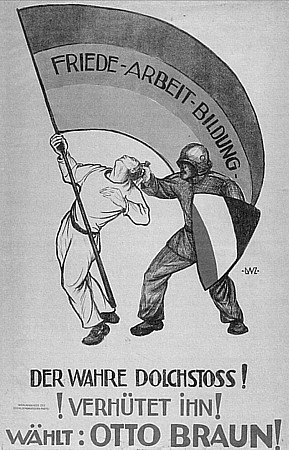
As a mere aspect of the state it is the individual's duty to submit to its needs, and worship it as a 'terrestrial divinity'. Consider the following quote as illustrative of the idea:
''Otto Braun, age 19, a volunteer who died in World War I, wrote in a letter to his parents: "My inmost yearning, my purest, though most secret flame, my deepest faith and my highest hope - they are still the same as ever, and they all bear one name: the State. 
One day to build the State like a temple, rising up pure and strong, resting in its own weight, severe and sublime, but also serene like the gods and with bright halls glistening in the dancing brilliance of the sun - this, at bottom, is the end and goal of my aspirations.''
Hegel's views are a fine example how volition, human free will, the essence of morality, is shifted from man to God, thus dodging human responsibility and lumbering God with the dire results of human free will.

'World historical figures' as operatives of God's Plan, might be exacting high cost in terms of human lives, but collective historical development is of a higher order than mere morality. This hierarchy of ethics sounds familiar.

The suspicion may be justified that the rift between the Enlightenment and the Counter-Enlightenment, the American-Continental fault-line, Locke versus Rousseau, is still visible today in the geopolitical differences between the United States and the European Union (Part I, The Counter Enlightenment).

Americans have taken up ownership of their politeia, safeguarded by the guarantees of the Second Amendment, ensuring the rule of law will be defended with something more impressive than corroded pitchforks and burning barricades.

Europeans on the other hand are still stuck in the mind-set of subjects. They have not given up being the pawns of Hegel's 'world historical figures', the new operatives of 'God's work' who happen to be carving out a heroic role for themselves as unelected road-builders to Kantian world government by the new world order.

Admittedly EU citizens were misled by their political leaders, but how else can one account for the civic tolerance of the collectivist, centralist super behemoth, the post-democratic techno-rule that is now controlling most of the continent and the United Kingdom? Is Hegel's hierarchy of ethics, the flow of 'world historic events' before individual rights - empire building before Enlightenment values - alive and kicking in the third millennium?

The EU recently betrayed its Hegelian credentials in the matter of the wave of Islamic fundamentalism that is encroaching on the Turkish secular democracy founded by Kemal Ataturk. The latter - knowing his Youngturks from his Liberals - made the military the custodians of the secular Turkish government.

In a recent crisis the EU made a perhaps not surprising, but very revealing choice. The military were to stay in barracks, Sharia come what may. This choice should not be interpreted as a mark of respect for the fundamentalists' freedom of conscience, because this liberty has already been officially subordinated to postmodern moral legislation.

This was a choice to sacrifice democracy, rather than save it by a military intervention, for putting the flow of 'world political events' before the values of liberal democracy. Statist habits die exceedingly hard, it seems.

Expert on anti modern Counter Enlightenment thoughtStephen Hicks, lists four of Hegel's contributions to postmodernity:

1. Reality is an entirely subjective creation (or, thought creates reality) (or, reality  for its existence is dependent upon the subjective mind); (a reversal of reason made possible by Kant, who enclosed the mind inside the skull, rendering knowledge of the external world impossible);

2. Ignoring Aristotle's law, contradictions were built into reality which made them a natural part of reason (from here onwards anything goes);

3. As reality evolves contradictorily, truth is not absolute, but relative to time, place and subject (the immediate victim of this logic is morality, the knowledge of good and evil);

4. The collective, not the individual, is the operative unit.

All this unfixed relativism and subjectivism may be surprising, but compared to the Counter-Enlightenment movement's later religious as well as atheist philosophers who have become known as the Irrationalists, Kant and Hegel sound like the sheer essence of reason.

NASA psychiatrist and blogger Dr Sanity has written extensively about the Counter Enlightenment and Hegel in relation to schooling and education, early victims of the 'new logic'. Here's a self-explanatory example:
- Left and Right Hegelians battling it out! -

"Ayers and his Cohorts are what's Wrong with Education Today"

Hegel, building on Kant, Rousseau and Fichte (next part), would go on to write, "It must be further understood that all the worth which the human being possesses--all the spiritual reality, he possesses only through the State." Hegel's heirs went on to divide into left- and right-wing camps. The charge of the left was led by leftists like Karl Marx, who transformed Hegel's "dialectic of Spirit" into an economic and social system that depended on godless dialectic of "oppressors versus oppressed." The right-wing Hegelians tended to stress the omnipotence of the state and were less willing to abandon a deity. For more than a 100 years, the two camps have been battling it out, each trying to impose their utopian vision onto the human species.

Both Hegelian offshoots summarily dispensed with free will and human freedom; and between them, they brought forth the philosophical abomination that we now call "postmodernism". The 20th century was the battleground where the two totalitarian branches of the collectivist philosophers vied for spiritual and physical control over humanity. The amount of death, destruction and misery they ushered in is perhaps unprecedented in human history.

By the mid-20th century, the right-wing, or nationalist, Hegelians, or National Socialists (Nazis) had been defeated by an alliance of the left-wing Hegelians and those who stood for human freedom and democracy. By the end of the century, the social systems favored by the Hegelians of the left had been exposed to the world for the lie and deception it was.

But, in this new century, both utopian systems have been given new life by recruiting a potent new ally in their attempts to control the minds of men. That ally is postmodern philosophy and rhetoric, which I have written about multiple times. This 18th century philosophical rise of collectivism is still playing itself out several hundred years later in the competing ideologies of our own time.

The most important battlefield in this war in our time is the educational system, from kindergarden through college, where strenuous efforts are being made by the remnants of both types of collectivists to claim the minds of the next generation. (...) >>>

Coming up next: "Flunking Fichte": "Education should aim at destroying free will so that after pupils are thus schooled they will be incapable throughout the rest of their lives of thinking or acting otherwise than as their school masters would have wished."


Related dossiers

- "Postmodern Ravages"

Wednesday, December 8, 2010

Ideological Archeology: Rousseau's Ravages (II)

Continued from part I: "The Counter-Enlightenment"

Swiss-French philosopher Jean-Jacques Rousseau's (1712-1778) personal life is marked by traits sounding awkwardly contemporary. Self-pity and paranoia play see-saw with wrong choices and deflecting blame. Man is by nature good, it is society that is the cause of corruption and vice. Iconic for Rousseauian thought is the image of the noble savage, man in his natural state before his fall from Paradise.

There is nothing ambiguous about his ethics however: he believed his 'doctrine of two substances' to be the key to the absolute quality of good and evil [Jonathan I. Israel, Radical Enlightenment, 2001, p., 2001, p. 719]. In an example in a classical setting he saw in Athenian decadence the degrading influence of reason. He preferred the cruder, militaristic Spartans, an unspoiled and nobler tribe. Their callous practice of exposing babies to nature - now in dispute - may well have inspired Rousseau to expose his own five illegitimate children to the hardships of the Paris orphanage.

Although Rousseau died in 1778, before the French Revolution, his justification of violence to power was the source of inspiration of the Reign of Terror that the Jacobins unleashed during the latter part of the rebellion. In 1792 the French 'citizen army' faced the Prussian forces at Valmy. In a psychological victory they prevented them from marching on to Paris to restore the monarchy. Earlier in the capital a mob had stormed the Tuilleries Palace. In the massacres over a thousand political prisoners were brutally hacked to death. Fabre d'Eglantine declared: "In the towns, let the blood of traitors be the first Holocaust to Liberty, so that in advancing to meet the common enemy, we leave nothing behind to disquiet us!" [Wildmonk]

After "the first Holocaust to Liberty" many more would follow. It is a specific feature, typical of Rousseau's constellation of ideas. The chief ingredients as expressed in "Profession de Foi" are a sweeping rejection of tradition, Revelation, and all institutionalized authority. [Radical Enlightenment, p. 718]

In Roussea's ideas we find the source of every anti-Liberal, violent revolution ever since the French Revolution went off the Lockean track. Rousseau is ultimately the father of many noxious and lethal, collectivist traditions besides: Romanticism, redistributive Socialism, philosophical agrarianism, conservative Communitarianism, Nazism, and more to the point, the Counter-Enlightenment and postmodernism (including anti-human ecofascism). Cultures, adopting Rousseauian ideas found in them a mirror of some aspect of their own identity. [Wildmonk]

Many have descended into the abyss of collectivist hell. In France his radical egalitarianism led to The Reign of Terror, in Germany to Left and Right Socialism with known result, in Russia and the Far East to communism, starvation and slaughter on grandiose scales. In China Mao Tse Tung's Great Leap Forward resulted in the greatest mass murder in human history and in Cambodia the Khmer Rouge's extermination campaign to establish Rousseauian agrarianism resulted in the deaths of well over twenty percent of the population. [Wildmonk] If this is not evil, frankly I don't know what is.

Why Rousseau is different
Rousseau stands apart in many respects. He marks the fault-line in Western tradition between Anglo-American and Continental lines of thought, and forms the point of departure from the Enlightenment because he is essentially anti-modern [Wildmonk]. While loosely following the traditional path of Enlightenment thought, his radical stance differs notably on the crucial issues of anti-individualism [Isaiah Berlin, "Against the Current", 2001], anti-capitalism and against private property ("Radical Enlightenment", p. 273), anti science and technology, his radical egalitarianism, and the inherent mindset in which the means are justified by the perceived noble end.

Rousseau is often quoted as the iconic philosopher of the Enlightenment, but it is quite clear he fiercely rejected all its tenets and values. No doubt, here we have the ground zero of the Counter-Enlightenment.

He was certainly no believer in mutually beneficial interaction, or the beneficial effects on society of self-interest (Bernard Mandeville (1670-1733), "The Fable of the Bees"), asserting that "society hardly needs to feed man's love for himself and his desire to be first among men." ["Radical Enlightenment", p. 273].

His radical egalitianism is echoed in the notion that rational and industrious man with dehumanizing machines would replace royalty as an enslaver of the common man, being better and more ruthless on the aggregation of material goods. He argued that the separation of the progress and dissemination of science and art from political and religious control are hazardous for society and for the virtue of the people [Bloom, 1990]. But it gets worse."

Common will" instead of freedom
In Rousseau we see the first social contract at the price of freedom and the birth of a notion called the "common will". The latter is a concept that in Rousseau's approach requires state intervention. This should not be confused with the 'common good'. It is a far more developed conception which, and unlike the former, can only be realized in the context of civil society under the state ["Radical Enlightenment", p. 720).

For the creation of a society of common will, "freedom of all the people", they need only accept the dictates of the state. This was Rousseau's essence of "true civilization." The struggle between rich and poor would then rise to a moral experience of self-restraint. [Wildmonk] With the faculty of moral choice thus abdicated and forfeited to the state, people would be free from lowly - earthly desires and reach full - ideal potential. Man is thus divorced from the social and economic context in which he lives and interacts with others. The ideal state of heaven, separated from earthly considerations.

This totalitarian approach to freedom, an abomination in every sense, was later further developed by Marx, who wrote that "capitalist, individual liberty is the most complete suppression of all individual liberty and total subjugation of individuality to social conditions" [Wildmonk: Marx, "Grundnisse", pp. 131]. "Freedom can only consist in socialized man, the associated producers, rationally regulating their interchange with Nature, bringing it under their common control, instead of being ruled by it as by the blind forces of Nature; and achieving this with the least expenditure of energy and under conditions most favourable to, and worthy of their human nature." [Wildmonk: Marx, "Selected Writings", pp. 496].

In this way man's separation from his nature and morality began. Never in human history were their worse judges of human character than Rousseau and his followers: all seek some degree of formal control over individual freedom for the purpose of creating material conditions deemed necessary for "true freedom", moralectomy in precise equal measure. Rousseau's concept of "common will" became the most savage, bloody instrument of social engineering in the history of mankind.

The Atlantic Ridge
In the United States Thomas Jefferson was the most prominent supporter of the French revolutionary achievements. Nevertheless, property rights and Enlightenment liberties were set in stone in the spirit of Locke, Montesquieu and Adam Smith. The present Democratic Party is being diverted further and further from that tradition as the sway of the postmoderns intensifies. Rhetorical style and attitude betray their influence.

While National Socialist and Communist ideas have swept America to some extent in their haydays - notwithstanding the counter culture, a product of the latter - these Rousseauian inspired ideologies remained by and large a marginal affair. Rousseau entering Locke's territory by the back- door may come as a surprise to some Americans - the wrong brand of revolution is encroaching on its most basic principles.

In Europe the situation was markedly different, as we shall see. Locke's influence remained on the whole limited to the British Isles. France and Germany have both Rousseau traditions, not Lockean. Today of great long-term concern is a possible return to some form of Rousseau inspired extreme ideology. It is chilling to see the rise of an unelected governing body on the European continent. The post-democratic elitism, combined with postmodern ideological chaos understood in the philosophical context, is an even more disquieting prospect.

Counter-Enlightenment projection* is on the order of the day and may even be consciously used as a tactic. Rousseau's brand of radical and revolutionary ideas, combined with the notion that civilization is so corrupt that it must be considered beyond salvation, makes him the father of all violent struggle in the last two and a half centuries.

Americans, tending to confuse Locke's revolution with Rousseau's, occasionally fall into the trap of supporting the wrong causes: initially the Russian Red Terror, and more recently, the covertly Islam inspired call for independence in the middle of Europe's powder keg, the Serbian province of Kosovo in the heart of the Balkans, thus providing a foothold in Europe for similarly based and equally pernicious radicalism.

The zero-sum game approach to economics also originates with Rousseau, which is giving rise to the annual media talking point that "a new report is suggesting that today's rich are getting richer, and the poor are getting poorer". This is incorrect propaganda, some reason requiring regular public re-affirmation, perhaps for that reason alone.

Rousseau and Religion
The great minds of the Enlightenment proper - Spinozists excluded - never saw Christianity as their mortal enemy. To them Church and the Enlightenment were natural allies. Rousseau was no exception, but he had only a passing acquaintance with the Christian political tradition. Therefore he dismissed the role of Christianity as a moderating force in society. He saw the faith as entirely a spiritual undertaking, occupying itself only with "heavenly things."

Rousseau's Christians are so detached from reality that they can hardly be recognized: a people so spiritualized that they display a profound disinterest if their earthly pursuits are successful or not. Rousseau's call for transcendent values to harness the energies of men towards the 'common will', coupled with the rejection of Christianity as a engine of these values, made it a central tenet of all the Rousseauian ideologies [Wildmonk].

To Rousseau religion was an imperative. "... the state cannot ... pursue a policy of toleration for disbelievers, or view religion as a matter of individual conscience. It absolutely must, therefore, reject dangerous notions of toleration and the separation of church and state." and "so fundamentally important is religion that the ultimate penalty is appropriate for disbelievers ..." [Stephen R.C. Hicks, "Explaining Postmodernism", Scholargy Press, 2004, p. 98].

Despite being so enamored with force-feeding religion, after the publication of his work "Emile" he was driven into temporary exile in Bern after a warrant for his arrest was issued. "Emile" was widely denounced as irreligious and seditious.

The Legacy
The loather of civilization, Rousseau was nevertheless greatly admired by the early Counter-Enlighteners, as he is by today's postmodernists. His followers mostly selected from his work what they could use to prop up their ideologies. Marx accepted Rousseau's critique of Locke's economic man but stood solidly by the Enlightenment in his appreciation for science and technology. Marx even went so far as to describe his ideology as Scientific Marxism, basically a pseudo scientific rationalization of his aggregate of ideas.

Hegel as well as Rousseau inspired Marx' theory of dialectic materialism, in which the theme is the dichotomy of the Oppressor versus the Oppressed. Now clearly a tactic of this dialectic, Rousseau's vista of a noble, primordial world destroyed by man's egoism, might well also have sired the epidemic of Western self-loathing.

Irony
Ironically, while Rousseau was convinced that civilization was the cause of moral degradation, little did he know that his followers, by rejecting objective reality, would drop morality along with it. Despite two and a half centuries of genocidal legacy in pursuit of Rousseauian ideal society, it enjoys considerable support among the Western intelligentsia, specifically in the humanities departments of academia, the media, all levels of education, contemporary arts, the political elite, advisory boards, government ministries and departments and what is loosely described as 'the corridors of power.'

The postmodern heirs remain committed to undermining free-market democracy, casting misty eyes upon the Rousseauean atrocities. 110 million dead are not vile enough to discredit 'the Party of Humanity' in the views of some of the most stubborn apologists. Considering that totalitarian societies are today's version of the tribal community he so admired, the Rousseau ideal society could well be described as an agrarian totalitarian state.

Another point of irony is that Rousseau's conviction, that reason engenders egocentrism has been falsified by every non-government sponsored humanitarian organization on the face of the planet, while Rousseau's faithful follower Hegel is responsible for the subjectivism that saw the birth of egocentrism gone mad, the 'Master of the Universe' syndrome (each individual creates his own personal version of reality: If I die overnight, will the sun still rise tomorrow?).

In France, Rousseau's ideal of small, intimate villages and a peaceful, agricultural society built on the consent of the common will has resulted in France becoming a by-word for centralized statism. Rousseau's tenet that reason caused man's fall from paradise may well be the basis of the later Counter-Enlightenment's political ideals, modelled on the re-creation of 'paradise on earth', Utopias which usually turn out to be dystopias instead.

Postmodernism or Rousseauism?
Rousseau can certainly be traced back as the source of all members of the postmodern coalition: environmentalists, third-worldists (Baran-Wallerstein), feminists, anarchists, 'gender, identity and sexual orientation' theorists, traditional socialists of various plumage, and 'classical' postmodernists. It is a true gathering of Rousseauians that has largely remained uninvestigated, underreported and certainly undeclared.

In the chaos of the total postmodern bankruptcy in the wake of mayhem, moralectomy and grandiose failure, there is but one purpose left. A resolve that brings these ideologies together with a tradition with which it has so much in common. We are witnessing a spontaneous feast of recognition with radical Islam.

It is truly remarkable that every prior held conviction and allegiance has by now been jilted in favour of furthering the causes of the intolerant: it's back to the Rousseau basics. The grant plan: a strategy to deconstruct Western, democratic, liberal capitalism by critical theory, and 'irrational means of the will.'

Up next: Emmanuel Kant: "I found it necessary to deny knowledge in order to make room for faith."

If you think of yourself as a peaceful, loving person, while actually you are full of wrath and hatred, the psychological coping device of projection - as if by magic - transforms the object of that wratch into someone who is hateful, devisive, full of vitriol and bile, bigoted, intolerant and hatemongering.

Related dossiers


Thursday, September 23, 2010

The Obama: the Marxist, Anti-Colonial African Colonial - Update

L.E. Ikenga is hot on the trail of D'Souza's wanting analysis in "The Obama Agenda and the New Global Elite". The Left were quick to categorize the article as "highbrow birtherism" (their assault themes are really getting quite worn at this stage). Ikenga deals with it without throwing around labels ad hominem:

Mr. D'Souza fails to understand is that post-colonialism ceased being a cantankerous "cause" or a "crusade" a long time ago. Instead, it now identifies a new way of thinking about the world in global terms. Post-colonialists have long since stopped attending "Reparations Now!" rallies and academic "roundtables" on race and politics. They are now the heads of liberally backed NGOs, Ivy League Institutes, or countries like the United States. (...) >>>
Read it all ...

September 14, 2010

Dinesh D'Souza is once again doing what he does best: narrowly missing at target practice. He gets the general drift and then dashes off after some red herring.

In an analysis on Forbes, "How Omaba thinks" he's bringing up a number of flabbergasting policy decisions by the Obama administration and concludes on that basis: "The President isn't exactly a socialist" and "Obama is a socialist--not an out-and-out Marxist, but something of a European-style socialist" to finally conclude Obama is actually an anti-colonialist.

D'Souza could do with a few courses Objectivism or perhaps study a tome on non-contradictory thought.

All Obama's policy decisions are perfectly explained by the Marxist narrative, which to a more or lesser degree and intensity follows the same simplistic, dialectical world view, broadly reading as follows:
The world is made up of two groups of humans: oppressors and oppressed. The battle is to entice away as much value as possible from the oppressors and hand it over to the oppressed. Since this is serious warfare and the ethical goal outweighs any other consideration, the end justifies the means.
The battle has been raging for almost two centuries.

In turn Marxism rests on the false theories of the German Idealist thinkers, notably Immanuel Kant and his follower Hegel who pushed the fallacy that the outside world - reality - for its existence is somehow dependent on man's mind (thought creates reality, or subjectivism). This is the basis of Progressivist thought.

While others have noted that Obama doesn't share the 'slave blood' of African Americans, the notion that Obama's background should be seen against the light of a black African, was first laid out in June of last year in an article on American Thinker by Nigerian born L.E. Ikenga. In the article the author explains the mental makeup of the typical African colonialist.

Ikenga's 'African colonials' have adopted a Western consciousness and took colonial thought and ideologies in order to advance the anti-colonial agenda, usually to the detriment of the former colony. All Obama is doing, is projecting the anti-colonial Dreams From His African colonial Father.

The same is true of Obama's 'Christianity'. On the basis of Islamic doctrine the case could be made Obama is formally a Muslim. But the fact remains, he's been sitting for over twenty years in the pews of the fire and brimstone emitting Reverend Wright, a typical exponent of Black Liberation Theology.

The tenets of postmodern Liberation Theology are in fact nothing more than a slightly Christianized version of the Marxist dialectic based on the Frantz Fanon's anti-colonial Sorelian myth, "The Wretched of the Earth".

Any doubts of Obama's Marxist root could be laid to rest by his early political exploits in the Marxist New Party (photos also here and do read all the Obama files on New Zeal).

That ultimately brought Obama to the highest office, where he's been redistributing value from his own quintessential 'oppressive' country - the USA - to those nations that share the Marxist dialectical world view, to wit Iran and its proxies, Brazil and a number of other Neo Marxist caudillo countries, the Chicoms, autocratic Russia, and the rest of the laundry list of beneficiaries, of allies thus far thrown "Under the Obama Bus".

Related

- Forbes: "How Obama Thinks", by Dinesh D'Souza
- American Thinker: "Obama, the African Colonial", by L.E. Ikenga
- Key Wiki
- Discover the Networks

Related dossiers

- "The Dialectics"
- "The Pomo Presidency"
- "Under the Bus"
- "Ruled by the Mob"
"The Obama Civil Defense Force"
"Stop The Obama Constitutional Crisis"
"Obama's Radical Connections"
"Postmodern Ravages"
"The Pomo White House"

Sunday, November 22, 2009

Hacking a Way Through the Hottest Hoax

Ever since Emmanuel Kant took up duplicitous sophistry - called by its Orwellian name "Pure Reason" - using false logic to lay the axe at the root of reason, we've seen this parlour trick used against the forces of Enlightenment, again and again. It is in fact a intricate equivocation wrapped in a dense layer of philosophical yada yada to cover up the intellectual shell game.

Kant's dialectic was followed by Hegel's, followed by Marx', followed by Nietzsche's and Heidegger's, followed by the Frankfurt School for cultural Marxism, followed by the contemporary postmodernists of the counter cultural revolution.

- Caption: Thomas Hart Benton's postmodern vision of “Hollywood” in 1937 -

If Marx' version of the dialectic consisted in pitting social classes against each other in which an intellection elite took power in bloody revolutions - ostensibly on behalf of the underdog - today's postmodernists build on a foundation laid by the Frankfurt School, which sought to subvert the free world from within. It was successful beyond their wildest dreams.

Today it's no longer just two social classes with rival interests facing each other, but a global plethora of minorities based on race, gender, religion, culture, geographical origins and national identity, opposing the first world's power made up traditionally of "white, dead males" based on cold reason, egoistic individual rights and selfish, economical development - or so the narrative goes.

The ultimate theater in which this global dialectic is played out is the transnational progressivist heist called the first world's "climate debt" to the third world. It's rooted in a postmodern version of Kant's "Pure Reason", now dubbed "True Science".

The "logic" underlying that narrative is that the West has been industrially revolutionizing itself for some two hundred years, foisting on the world evil devizes it has not asked for: steam engines, ocean vessels, aeroplanes, space rockets, motorcars, refrigerators, washing machines and all those other nefarious consumer implements from hell.

Needless to say that - in analogy of Marx' dialectic - all this revolutionizing went over the backs of peoples located in remote areas on the other side of the globe.

The phenominal world of the dialectics is not just an equivocation, it's rather blunt, dumb and unsophisticated to boot: everything is a zero sum game. Hence the Western world is now handicapped with a "climate debt" to the tune of one hundred billion dollars. Fuzzy math by tranzie officials has calculated that the US percentage of the debt stands at 30%, while the EU's is limited to some 25% (China's by comparison stands at just 5%). Most undeveloped or underdeveloped countries are net receivers.

Quite conveniently the blessings of all these discoveries and inventions are ignored by the Luddites (a better term would be Rousseauians). The sophistry of the dialectic has once again turned reality on its head: development is evil, stagnation is good. And thanks to habit of Western member countries of depositing their worst Socialist political surplus at transnational institutions and world bodies, there's no one in NGO'ism or at the UN available to point out the fact.

COP15, a tranzie code word for the Treaty of Copenhagen, the successor to the Kyoto Protocol, is looming large in a few weeks time. Barack Obama is perceived to be holding the keys to the agreement, having been bribed ... eh, encouraged for the purpose with a preemptive Nobel Prize for eco justice.

- Caption: the exploitation of children is not beyond the means that justify the aim, otherwise covered by the Kantian ethics of good intention: a natural phenomenon as old as the world is now a "man-made" disaster (mea maxima culpa); the good news is that guild can be bought off -

This is why the hacking last week of the University of East Anglia Climate Research Unit, home institution of one of the world’s centers of research into anthropogenic global warming (AGW), comes as a gift from heaven, hopefully just in the nick of time to prevent the egalitarian nightmare of World Socialism from becoming reality. The event - "ClimateGate"- is already shaking the world of "denialists" to the core.

That the lamestream media has managed to ignore the story so far, is indicative of the measure of evasion they are capable of in this hottest hoax and everything else that doesn't fit their construed version of reality. Update: something's being spun right now! James Delingpole of the UK's Telegraph who scooped the story, has a round up (Delingpole's site).

Pajamas Media: "Global WarmingGate: What Does It Mean?", by Charlie Martin

Late on the night of of November 19, news broke on PJM and elsewhere that a large amount of data had been stolen from one of the major climate research institutions by an unknown hacker and made available on the Internet. (...) The hackers released about 172 megabytes of data, and we can be sure examining it closely will take some time. But after a few days, certain things are beginning to become clear.

The data appears to be largely, perhaps entirely, authentic. The emails are incendiary. The implications shake the scientific basis for AGW (anthropogenic (man-made) global warming), and the scientific reputations of some of AGW’s major proponents, to their roots. Let’s look at the files and emails first. (For a running list of the interesting emails, see Bishop Hill’s list.) (...) >>>

Wiki Leaks

Read at all! >>>

Related dossiers:

- "Greenism" (contains more links to this subject)
- "Transnational Progressivism"
- "The Dialectics"
- "Socialist Causes Explained"

Related posts:

- "Red-Green Radicalism Has Sprouted Wings"
- "The 'Brother Species' Just Hate Us"
- "Cosmology and Aim of the Progressive Narrative" (series)
- "Global Warming: A Problem Not Supposed to be Solved"

Updates will be posted on the "Greenism" file. Just this: Terence Corcoran brings up another problem: the unscientific, through and through politicized way in which the facts have been bent to fit the theory, may cause outcry in the same anti modernist camp that this spells the end of science. The irony will come full circle: after Kant destroyed rationality through his fallacy of Pure Reason, it will be the True Science of the climatists that will mark the end of the epoch of Enlightenment. Beware!!!

National Post: "After Copenhagen, the end of the science"


Reblog this post [with Zemanta]

Sunday, April 26, 2009

Transnationalism: Manmade Disaster or 'Evolution'


In the present discussion with Carl Rove and John Bolton at Glenn Beck's we see the ongoing disaster known as transnationalism clearly presented as a manmade process: it is pushed by people and politicians with an agenda.

According to others a world government is the logical outcome as man progresses on his way through history and evolution.

This meme is the result of a two centuries old phantasy, a theory set out by the reactionary philosophers Kant and Hegel who saw it as the outcome of man passing through history, bringing himself on higher levels of morality through strife and struggle.

This dualism has come to us in the form of the Marxist dialectic, which was based on Hegel's dialectic. On that basis one might say, Transnationalism is world Socialism by the backdoor.

At least Kant had the foresight to accompany his prediction with the caution that this world government might well be the "greatest tyranny ever seen". This is the state of affairs in the Third Millennium.

- Filed on Articles on "Hegel's Legacy" and "Transnational Progressivism" -

Saturday, February 28, 2009

The Evolution from Value to Non Value

For reasons we shall see shortly many people today have lost track of the meaning of the word 'value'.

It means simply - within an ethical system - something worthy of pursuit and effort to keep it.

In the relativist Marxist dialectic and its frame of ethics, morality became a social construct of the Oppressors - i.e. the bourgeoisie. Middle class values became synonymous with the concept itself.

Like the entire field of ethics came to be defined in accordance with the Kantian ethics system, and 'morals' are understood as limited to sexual behavior, for entire swathes of Westerners 'value' currently means 'suspect middle class decency', usually slightly false and hypocrite. Value became a non value.

Pop culture consists almost entirely of non values, and even anti values. No one pursues health hazards, ugly things, refuse, dilapidated buildings, rags, music as a loose jumble of unrelated sound waves, ditto in literature (word salads), faecal art, urinals, and anything else skatological. In short, that which in real life we need to get away from as soon as possible because it's, well ... worthless -- valueless.

Postmodern art and culture tries to sell us refuse - non values - as if they were a value, something worth pursuing and keeping ... in effect, anti values.

The entire edifice of Left and Right collectivist ethics, is based on a fallacy (not reality as it is, but as it should be, according to their false ideologies) and the subterfuge, that aims to persuade us that what we see in front of us, is an illusion and thus unworthy of pursuit.

The consequence is the upside down, relativist world we live in today: in which our senses are said to be deceiving us and man is thus incapable of knowing anything (epistemological nihilism); black is white from a certain point of view and true (subjectivism); that reality will cease to exist at the moment of our death because it is 'thought that creates reality'.

Much has been said about the parallels of the Weimar Republic in the German interbellum, and the present times. In reference to values this is most certainly true: the same postmodern non and anti values in art and culture, and in society rampant relativism, sexual deviasion and permissiveness, and an obsession with death and the gruesome.

Yesterday Dutch TV aired an interview with a young Muslim woman who was in the Turkish Airlines plane crash at Amsterdam airport this week. The interviewers, who never hesitate to brutally deride and ridicule Christian believers, softly-softly pushed her on her beliefs and the Muslim approach to the afterlife.

She explained that in Islam our earthly life is not something worthy of great pursuit, and that real life, is the afterlife. It is in the unity with Allah that true life begins. While the same thought has certainly crossed the minds of many Jews and Christians, for a very good reason the basic credo has always been the absoluteness of the sanctity of life. This is but one basic aspect why the three faiths of the book are not "all the same".

Any other inference that may be drawn from that premise for the moment aside, it is obvious that to her and her co-religionists death is clearly a value, while life is not. Now, answer the question, why would anyone devise a thought system that makes death a worthy pursuit?

The conclusion is justified that two and half millennia worth of civilization is currently under attack by some form of nihilism, on some level or other: ethically, epistemologically, metaphysically, culturally, ideologically, politically, you name it!

Hampered by idealistic collectivists who are naive enough to have put their money on a happy, post Christian and post racial global cumbaya, and caught in a pincer between on the one hand, nihilistic postmoderns who lost their belief in anything, hell bent on tearing down the rest of humanity with the demise of their morally bankrupt ideals; and on the other hand the Islamic collective of the Ummah that is obsessed and in the throngs of a fanatical death cult.

Boy, are we knee-deep in skatological goo ...

Thursday, October 30, 2008

Obama is NOT the Most Liberal Liberal to Have Run for Office

On the late day the news was suppressed that a major Obama speech writer has broken rank, rummaging through an rather amusing PUMA blog - Hillbuzz - the winning meme hit consciousness level: Obama is not at all "the most liberal Democrat that’s run for president in as long as anyone can remember" ...

... Obama is NOT a liberal at all!

In "The Hidden Sinisterisms of the O Campaign" we introduced Global Labor, a unionist blogger who is perturbed by the Obama 'authoritarian' influence on education. He asserts that Obama's eduction adviser, Prof. Linda Darling-Hammond - like Ayers - is persuaded of the justice of the 'educational debt', reparations due to black citizens as 'historically oppressed." This theme is classical Marxist dialectic, pointing to the Marx assertion that Capitalism breeds happy peoples because it exports oppression to the Third World (never mind that African Americans are well, Americans).

If Obama doesn't share the Marxist beliefs with his former Chicago Annenberg Challenge board colleague Ayers, then why does he have (or has had) Mike Klonsky serving on the campaign blogs, answering matters pertaining to education and 'social justice', as Global Labor alleges? Both Klonsky and Ayers emerged from the SDS: whereas Ayers started his Weather Underground mob, Klonsky - via the October League - founded the US Communist Party (Marxist-Leninst) (CP (ML)), which was officially sanctioned by the Chinese regime.

The confusion in the political landscape could not be more profound. A leading Dutch magazine came up the other day with "Dutch liberals might become disappointed in Obama, because he is not as liberal as they think he is". That would be because - in order to win American Presidential elections - candidates have to 1. pretend to respect the 2nd Amendment (right to carry arms); 2. support the death penalty; and 3. pretend to be a Christian of sorts. The case is however altogether different.

No, Barack Obama is no liberal, and certainly not The Most Liberal Ever. He's an old fashioned, authoritarian, top down, commie nomenklatura. It's John McCain who's the real liberal, as some would have it ...

Every so often in this blog we make an effort to explain what is wrong with the current entrenched alignment of political parties, and that the American notion of liberals and liberalism is flawed. The last time we made such an attempt was in "Credit Crunch Critical for Survival of Capitalism." The American uptake of liberalism is actually Socialism light, which is directly opposed Libertarianism.

Confused? Luckily we now have the availability of the online Ayn Rand Lexicon in which the matter is explained better than we could ever aspire to. Consider:

"For many decades, the leftists have been propagating the false dichotomy that the choice confronting the world is only: communism or fascism—a dictatorship of the left or of an alleged right—with the possibility of a free society, of capitalism, dismissed and obliterated, as if it had never existed.

The political origin of that notion is more shameful than the “moderates” would care publicly to admit. Mussolini came to power by claiming that that was the only choice confronting Italy. Hitler came to power by claiming that that was the only choice confronting Germany. It is a matter of record that in the German election of 1933, the Communist Party was ordered by its leaders to vote for the Nazis—with the explanation that they could later fight the Nazis for power, but first they had to help destroy their common enemy: capitalism and its parliamentary form of government.

It is obvious what the fraudulent issue of fascism versus communism accomplishes: it sets up, as opposites, two variants of the same political system; it eliminates the possibility of considering capitalism; it switches the choice of “Freedom or dictatorship?” into “Which kind of dictatorship?”—thus establishing dictatorship as an inevitable fact and offering only a choice of rulers. The choice—according to the proponents of that fraud—is: a dictatorship of the rich (fascism) or a dictatorship of the poor (communism). That fraud collapsed in the 1940’s (...) >>>

(...) apparently somebody forgot to inform the West.
______________________________________________________________
"The truth is, in order to get things like universal health care and a revamped education system, then someone is going to have to give up a piece of their pie so that someone else can have more."
--Michelle Obama, the first lady of zero sum economics


- Filed on Articles in "The Dystopia of Paradise" -

Thursday, July 31, 2008

The Anti-Human Philosophy of Darwinism

An article by Dinesh d'Souza on Townhall in clarification of a recent al Jazeera broadcast in which he was juxtapositioned to Richard Dawkins, shoots once again to the forefront the fruitless discourse on Darwin's Theory of Evolution on the one hand, versus Creationism and Intelligent Design (ID) on the other (the latter a legal collation).

D'Souza, author of "What's so Great About Christianity," before joining the Hoover Institution, was the John M. Olin Fellow at the American Enterprise Institute. Dawkins authored "The God Delusion" and is a well known Skepticist whose wiki biography fails to disclose any political activities other than anti Vietnam and anti Iraq War reflexes.

Dawkins is a proud Skepticist. Skepticism itself is a Naturalistic theory which holds that man is incapable of acquiring knowledge about reality. It even rejects consciousness and reduces man to the animal level. The term Skepticism by its Greek root σκεπτω, to think, suggests reason, but on the contrary, the theory excludes it. Skepticism is endemic in current academia.

Dawkins' credentials as a Postmodern anti-humanist are indicated by his involvement in the Great Apes Project, which seeks to reduce humans to the moral level of gorillas, and his close association with bio-ethicist Peter Singer, a well-known advocate of infanticide in the service of animal liberation, both suggesting that the distinction between man and animal is meaningless to Dawkins.

Returning to the discourse on evolution versus creation, it is clear from the outset that this false, unscientific dichotomy is leading nowhere. Any explanation for the origin of life other than the two polarized options are a priori excluded from the debate for reasons of Postmodern sophistry. The reason lies in a rather dishonest debating technique, a parlor trick in which Postmodernists excel: recasting the subject in a caricature of itself after which - exposed to ridicule - it can safely be condemned as 'obviously invalid.'

As d'Souza explains the reason why relativist thinkers cling dogmatically to Darwin's unproved theory is that it provides them with the 'scientific' basis for the atheist ideology. This in turn explains the fanaticism and the close-mindedness displayed since the 1880's and why Charles Darwin - like Sigmund Freud - has been included in the Marxist pantheon.

Out-of-the-box, often exact scientists (the real ones) working in the field known collectively as Intelligent Design, are lumped in with Creationists proper after a US lawsuit (see Part I) declared the two metaphysical explanations legally 'identical.' But compare the Biblical story with this explanation of ID and it becomes plain that equivalencing the two only exists in terms of a political agenda: the Darwinists'.

Since then any suggestions, other than evolutionist, are confined to a particularly nasty corner of the atheist hell specially reserved for 'Christians and other primitive Flat Earthers.' The picture is meant to conjure up the vista of Galileo's enlightened heliocentricity, said to have been suppressed by the obscurantist Renaissance Church.

The cases are is not dissimilar, but the Catholic Church authorities displayed a far more open, scientific mind-set than Galileo and Postmodern Darwinian absolutists combined: the Galileo denunciation by the Church lay in the fact that he insisted on his theory being taken as empirically proved, while in fact this was not the case.

The same is true for Darwin's theory. Luckily for Galileo, he later turned out to be right; this remains however to be seen in the case of Darwin and his pomo followers, who prefer shutting up dissent: the result is that their theory increasingly takes the shape of dogma, and that scientists think twice before publicly venturing a fresh hypotheses. As far as research in the field of the origins of life are concerned, we are in a scientific dark age.

The application of Darwinism to other fields is rejected by both debaters, but in the case of Dawkins, this position is questionable: like Muslims, pomos are allowed to lie to their opponents.

D'Souza - himself a Darwin follower - explains that the theory as posited by Darwin had no bearing on the origin of life itself, or indeed on human consciousness.

Dawkins for his part - although he declared Darwinism to be applicable to cultural traits (memes) - in Part II of the program rejects social Darwinism: not its existence, but advocating it. Of course Dawkins would reject social Darwinism: in the eyes of its adherents socialism does little else but counter it and compensate its perceived victims from the negative effects; the core tenet of the dialectic is progress through strife and conflict between 'the Oppressors and the historically Oppressed'. Of racial Darwinism as invoked by Nazi ideology, Dawkins pretends not to be aware; he prefers to patronize his interlocutor and ridicules him as 'illogical,' a flat earther.

Typically Dawkins prefers to start indoctrination of the dogma as early as possible: children ideally should be exposed to the correct ideology from the age of eight, rather than their middle teens when the faulty epistemological basis has already been formed; after Fichte it is well known that free enquiry and dissent must be crushed as early as possible.

We see that relativist thinkers use the Christian approach as an excuse for the relativist anti-humanism. The Biblical principle that God created man in His image leads not only to the fundamental objectivity that all men are created equal (also rejected by relativism); but the same teaching laid the cornerstone as well for the anthropocentrism that relativists so fiercely denounce. Man is not Nature's lord and custodian, but its usurper. Down with civilization, long live Rousseau's noble savage!

What seems at first glance to be a legitimate debate on a existential issue which may be approached from a religious, philosophical or sccientific angle, can on analysis be reduced to the usual boring banalities of the Postmodern political agenda: a ploy for the deconstruction of Western civilization through the anti-modern dialectic (sigh ...).

Links to the Al Jazeera broadcast:

- Part I
- Part II
- ID explained: for followers of 'thought creates matter' ID is only one step away

- Filed on Articles in "The Dialectics" and "Life Ethics" -

Thursday, July 3, 2008

The Dialectics: the Strategy Against the West

On the Articles pages information and links are compiled per subject in files or dossiers. One such file way overdue is on the various dialectics and the phenomenon of petty political correctness.

Much has been said and written on the subjects, but the true purpose and origins are seldom reduced their roots. This file seeks to remedy that hiatus. The following text will be transcribed to the Articles section as an introduction to the subject.

In reaction to ultra rational positions taken by the later thinkers of the Enlightenment, a brand of 18th century German intellectuals sought to save the old order by undertaking a cultural movement countering the rationalist influences. These reactionaries are known as the German Idealists, the Romanticists, the Counter-Enlightenment movement, or the anti-modernists.

In the effort, anti-modernist philosophers Kant (1724-1804) and Hegel (1770-1831) sought to square Judeo-Christian cosmology with reason.

Kant saw philosophy as a grey area between science and religion and made it the battleground in the war on reason. His rescue effort resulted in the corruption of all three fields. Philosophy - in Aristotelian and Thomist hands a precision instrument for the exploration of reality - has never recovered from Kant's speculative theories about the nature of thought.

Kant devised a dialectical mechanism which was later further developed by Hegel to reflect contradictions: the dialectic of contradictory elements, also known as 'new reason,' making them part of reality. Thereby he inflicted on the world the self-perpetuating mechanism for progress through strife and conflict. A practical application we see around us every day is the adversarial approach to communication, common to the journalists, lawyers and politicians.

Hegel skewed Kant's proposition by replacing God with the State. Later followers posited further variations on such themes, creating in effect secular pseudo religions. This is the origin of mystical nationalism and of malignant racial and cultural theories, including Postmodern multiculturalism.

Hegel's followers divided into Right, and Left (or Young) Hegelians. Young Hegelian Karl Marx (1818-1883) further developed the dialectic, devising yet another skewed version (dialectical materialism) of Hegel's skewed version.

Marx' paranoid vision of society has divided the world into two species of humans: the oppressors and the oppressed, resulting in a perpetual struggle of minority groups against the 'power structure.' The latter should not be understood as simply 'those in power', but rather 'those in power, other than us'.

Contemporary postmodernism in whom Right and Left Hegelians have re-united (yes! their are quite a few closeted Nazis there), harnessed political correctness to today's version of Marx' class struggle. Rousseau's vista of a noble, primordial world destroyed by the logic of man's egoism and drive for civilization, might well have sired the epidemic of Western self-loathing. But it is now part and parcel of the postmodern dialectic: political correctness, a mechanism for self-control along the lines of direct action or positive discrimination with the aim of establishing redistribution of power and rights.

This dossier aims to compile examples of the practical applications of the postmodern dialectic. These often takes the shape of contemporary multicultural and social ideas concerning minority groups.

The overt, narrow objective is the liberation of the minority in question (women's lib, black power, gay rights, etc.) with the view of shifting power and rights from the 'white males power structure' to minority victim groups (everyone else). In the Pragmatist expediency this moral aim justifies any means, but methods of self-control through moral, social pressure are very popular today.

The ultimate aim however goes far beyond the narrow collective group interest: the deconstruction from within, of Western culture as it developed over the course of three millennia.

The next step on that path was set when the Left recently abandoned the patronage of the traditional historically oppressed groups in favour of their enemy, Islamism: its potentially deconstructive powers are simply too promising to pass up. The fact they have made the shift without any visible signs of cognitive dissonance says much about the ruthlessness of the underlying ideology. Next stop: 'borders are immoral.'

Dossier:

Pajamas: "Saving the Males From the NY Times," by Bernard Chapin

Members of the mainstream media not only cherish alternative lifestyles; they also wish to purge everything from our culture that prevents their realization. This was evident on Father’s Day when the New York Times Magazine commemorated the holiday by placing the misandric query, “Will Dad Ever Do His Share?,” on its cover. Inside is a lengthy expose by Lisa Belkin on this subject entitled “When Mom and Dad Share It All.” Those familiar with the contents of the Gray Lady will be unmoved by yet another attempt to denigrate fathers. After all, fulfilling the needs of politically correct oppression merchants practically has become the paper’s central purpose. (...) >>>

- Filed on Articles in "The Dialectics" -

 
RatePoint Business Reviews