Pages

Showing posts with label Immanuel Kant. Show all posts

Saturday, January 8, 2011

Ideological Archeology: Flunking Fichte (V)

Continued from Part IV: Heckling Hegel

"Education should aim at destroying free will so that after pupils are thus schooled they will be incapable throughout the rest of their lives of thinking or acting otherwise than as their school masters would have wished."

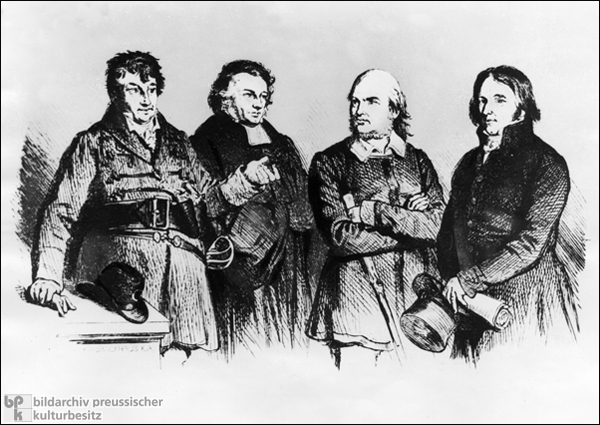
Meet the Professor from hell, Johann Gottlieb Fichte (1762-1814), Head of Philosophy and Psychology Dept. of the Prussian University of Berlin, in 1810.

He blamed all but God for the German defeat against Napoleon Bonaparte: corrupt royals, the nobility, the decadent influence of reason, and a succession of weak governments that undermined religion as a moral force. He wanted the German losers to emulate the burghers of the Middle Ages, who made the Holy Roman Empire great because they weren't individuals, but sacrificed to the common good.

The emphasis in Fichte's educational system was on compulsion, like Kant pushing duty for its own sake and the elimination of self-interest; obedience, the crush of free will, prohibition, fear for punishment, religious immersion--pupils must become 'fixed and unchangeable machines' and 'links in the eternal chain of spiritual life in a higher social order.'

Fichte applied Kant to education, as generations of continental school children, until well within the last century, may have been aware of, although perhaps not consciously so.

"Under proper guidance, the student will find at the end that nothing really exists but life, the spiritual life which lives in thought, and that everything else does not really exist, but only appears to exist."
A belated reaction to Fichte's will-crushing - but in full accordance with the extremes of the Hegel dialectic - was provided by Frankfurt School inspired anti-authoritarian education of the seventies of the last century. The Head Master from hell has become the guidance counsellor called Bill.

- Four German Idealists: Johann Gottlieb Fichte, Friedrich Schleiermacher,
Friedrich Ludwig Jahn, and Ernst Moritz Arndt (undated Woodcut) -
As National Socialism differed from Marxism in the national versus the international context, intellectuals of the Counter-Enlightenment movement exerted German, ethnic subjectivism. In Fichte's case, on education:
"Only the Germans, the salvation of Europe from the Napoleontic Enlightenment, are capable of true education."
In Fichte we have a good example of Left and Right Socialism as mirroring ideologies, not as opposing social systems. Like so many of the anti-modernist movement, he was undoubtedly a man of the Right, but pursuing what would today be seen as a Leftist subject: egalitarian public education.

First elected President of the Weimar Republic, the Social Democrat Friedrich Ebert in his inaugural speech in 1919 stressed the relevance of the Rightist Socialist, Fichte:
“In this way we will set to work, our great aim before us: to maintain the right of the German nation, to lay the foundation in Germany for a strong democracy, and to bring it to achievement with the true social spirit and in the Socialistic way. Thus shall we realize that which Fichte has given to the German nation as its task.”
The Head Master from hell may well have inspired Marx to view school as a microcosm of Utopian society.

- This post wraps up this series Ideological Archeology on the founders of the Counter Enlightenment or anti modernism, the precursor to Postmodernism. -
Update: Dr Sanity: "Ayers and his Cohorts are what's Wrong with Education Today"

Related dossiers

- "Education"
- "Postmodern Ravages"

Sunday, December 26, 2010

Ideological Archeology: Heckling Hegel (IV)

Continued from Part III: "Countering Kant"

Georg Wilhelm Friedrich Hegel (1770-1831), was like Immanuel Kant (Part III), a great admirer of Jean Jacques Rousseau (part II). Like today's cosmologists are warping reason for their Holy Grail, the 'theory of everything', these anti philosophers of the Counter Enlightenment did the same in their efforts to unify faith and reason.

Hegel feverishly sought to square Christianity with reason. In his efforts he made an irrational decision: he allowed Kant's dialectics to reflect the contradiction.

Hegel's follower, Karl Marx thought this was all wrong and devised his own version of the dialectics, which is with us until this day as a divisive mechanism for progress through class struggle.

Hegel's philosophy is a secular fantasy based on Judeo-Christian cosmology: God's projection, a spirit called the Absolute, represents creation which is seeking reunification with God. Its development through struggle and conflict by means of which it gets to know itself, is the story of the history of the world. The story ends when the Absolute - reunited with God - achieves full self-consciousness.

Hegel's theme was the state. As Rousseau is the father of the totalitarian state, Hegel is the founder of the collective state. The Orwellian term, 'freedom through the state' describes well where Hegel is coming from.

According to Hegel freedom is not a God-given right, inherent in man and therefore inalienable as the Enlighteners held it, but is temporary and conditional, granted and taken by the state as it sees fit.

Under the principle 'as above, so below' the state is acting as the instrument of God. It is the 'ethical whole', the 'actualization of freedom', and the self-consciousness of the Absolute.

As a mere aspect of the state it is the individual's duty to submit to its needs, and worship it as a 'terrestrial divinity'. Consider the following quote as illustrative of the idea:
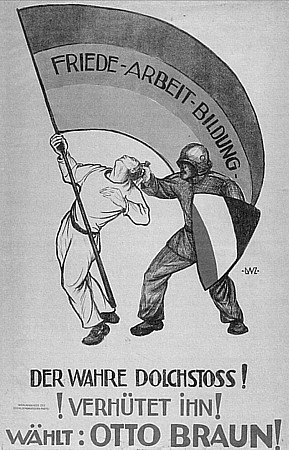
''Otto Braun, age 19, a volunteer who died in World War I, wrote in a letter to his parents: "My inmost yearning, my purest, though most secret flame, my deepest faith and my highest hope - they are still the same as ever, and they all bear one name: the State. 
One day to build the State like a temple, rising up pure and strong, resting in its own weight, severe and sublime, but also serene like the gods and with bright halls glistening in the dancing brilliance of the sun - this, at bottom, is the end and goal of my aspirations.''
Hegel's views are a fine example how volition, human free will, the essence of morality, is shifted from man to God, thus dodging human responsibility and lumbering God with the dire results of human free will.

'World historical figures' as operatives of God's Plan, might be exacting high cost in terms of human lives, but collective historical development is of a higher order than mere morality. This hierarchy of ethics sounds familiar.

The suspicion may be justified that the rift between the Enlightenment and the Counter-Enlightenment, the American-Continental fault-line, Locke versus Rousseau, is still visible today in the geopolitical differences between the United States and the European Union (Part I, The Counter Enlightenment).

Americans have taken up ownership of their politeia, safeguarded by the guarantees of the Second Amendment, ensuring the rule of law will be defended with something more impressive than corroded pitchforks and burning barricades.

Europeans on the other hand are still stuck in the mind-set of subjects. They have not given up being the pawns of Hegel's 'world historical figures', the new operatives of 'God's work' who happen to be carving out a heroic role for themselves as unelected road-builders to Kantian world government by the new world order.

Admittedly EU citizens were misled by their political leaders, but how else can one account for the civic tolerance of the collectivist, centralist super behemoth, the post-democratic techno-rule that is now controlling most of the continent and the United Kingdom? Is Hegel's hierarchy of ethics, the flow of 'world historic events' before individual rights - empire building before Enlightenment values - alive and kicking in the third millennium?

The EU recently betrayed its Hegelian credentials in the matter of the wave of Islamic fundamentalism that is encroaching on the Turkish secular democracy founded by Kemal Ataturk. The latter - knowing his Youngturks from his Liberals - made the military the custodians of the secular Turkish government.

In a recent crisis the EU made a perhaps not surprising, but very revealing choice. The military were to stay in barracks, Sharia come what may. This choice should not be interpreted as a mark of respect for the fundamentalists' freedom of conscience, because this liberty has already been officially subordinated to postmodern moral legislation.

This was a choice to sacrifice democracy, rather than save it by a military intervention, for putting the flow of 'world political events' before the values of liberal democracy. Statist habits die exceedingly hard, it seems.

Expert on anti modern Counter Enlightenment thoughtStephen Hicks, lists four of Hegel's contributions to postmodernity:

1. Reality is an entirely subjective creation (or, thought creates reality) (or, reality  for its existence is dependent upon the subjective mind); (a reversal of reason made possible by Kant, who enclosed the mind inside the skull, rendering knowledge of the external world impossible);

2. Ignoring Aristotle's law, contradictions were built into reality which made them a natural part of reason (from here onwards anything goes);

3. As reality evolves contradictorily, truth is not absolute, but relative to time, place and subject (the immediate victim of this logic is morality, the knowledge of good and evil);

4. The collective, not the individual, is the operative unit.

All this unfixed relativism and subjectivism may be surprising, but compared to the Counter-Enlightenment movement's later religious as well as atheist philosophers who have become known as the Irrationalists, Kant and Hegel sound like the sheer essence of reason.

NASA psychiatrist and blogger Dr Sanity has written extensively about the Counter Enlightenment and Hegel in relation to schooling and education, early victims of the 'new logic'. Here's a self-explanatory example:
- Left and Right Hegelians battling it out! -

"Ayers and his Cohorts are what's Wrong with Education Today"

Hegel, building on Kant, Rousseau and Fichte (next part), would go on to write, "It must be further understood that all the worth which the human being possesses--all the spiritual reality, he possesses only through the State." Hegel's heirs went on to divide into left- and right-wing camps. The charge of the left was led by leftists like Karl Marx, who transformed Hegel's "dialectic of Spirit" into an economic and social system that depended on godless dialectic of "oppressors versus oppressed." The right-wing Hegelians tended to stress the omnipotence of the state and were less willing to abandon a deity. For more than a 100 years, the two camps have been battling it out, each trying to impose their utopian vision onto the human species.

Both Hegelian offshoots summarily dispensed with free will and human freedom; and between them, they brought forth the philosophical abomination that we now call "postmodernism". The 20th century was the battleground where the two totalitarian branches of the collectivist philosophers vied for spiritual and physical control over humanity. The amount of death, destruction and misery they ushered in is perhaps unprecedented in human history.

By the mid-20th century, the right-wing, or nationalist, Hegelians, or National Socialists (Nazis) had been defeated by an alliance of the left-wing Hegelians and those who stood for human freedom and democracy. By the end of the century, the social systems favored by the Hegelians of the left had been exposed to the world for the lie and deception it was.

But, in this new century, both utopian systems have been given new life by recruiting a potent new ally in their attempts to control the minds of men. That ally is postmodern philosophy and rhetoric, which I have written about multiple times. This 18th century philosophical rise of collectivism is still playing itself out several hundred years later in the competing ideologies of our own time.

The most important battlefield in this war in our time is the educational system, from kindergarden through college, where strenuous efforts are being made by the remnants of both types of collectivists to claim the minds of the next generation. (...) >>>

Coming up next: "Flunking Fichte": "Education should aim at destroying free will so that after pupils are thus schooled they will be incapable throughout the rest of their lives of thinking or acting otherwise than as their school masters would have wished."


Related dossiers

- "Postmodern Ravages"

Saturday, December 18, 2010

Ideological Archeology: Countering Kant (III)

Continued from Part II: " Rousseau's Ravages" 

Often erroneously classified as part of the Enlightenment, Immanuel Kant (1724-1804) in his mindset is entirely antithetical to the values of that movement: he is a collectivist and is the inventor of subjectivism. His is not the mind of a scientist, but of a religionist.

The revered Kant is also a wee bit intellectually dishonest. His 'trick' was to stretch reason beyond the limits of what is reasonable and then used the outcome to discredit it. It culminated in his critique of "Pure Reason". Postmodernism has made it its own, and applies it in every argument. In his Second Preface of the first Critique he writes that he found it ...

"necessary to deny knowledge in order to make room for faith." ...
These are hardly the words of a scientific thinker. Kant was an austere Lutheran Pietist and a great admirer of Rousseau. The individual to him represented little more than a miserable sinner in need of a strong master, only good as canon-fodder to teach some morals.

The Second Coming
Kant foresees in a teleological progress towards an end-game by means of strive, war and discord. This supposedly brings man as a species to a more ethically evolved order. The process will ultimately culminate in a world government, an international and cosmopolitan federation of states, awaiting the coming of the Day of Judgment. This is the Hidden Plan of Nature, according to Kant. But he was so honest to admit that this might as well lead to the greatest tyranny imaginable.

You think?! Progressivism and the new world order, anyone? While the Enlighteners worked towards the separation of Church and State, the philosophers based on Rousseau, Kant and Hegel - even the atheists - confusing 'is' with 'ought' (Hume's Law), reverted to recreating 'paradises' on earth, now synonymous with collectivist distopias.

The tenets of the Enlightenment were abandoned and replaced by philosophical principles reflecting reliigion: realism made way for idea-lism, and individualism for collectivism; intuition and revelation were adopted as sources of knowledge rather than reason and experience, social theories replaced liberal capitalist theory.

The Incarcerated Mind
While today's postmodernists are mostly virulent atheists, they are at root adept followers of Rousseau, Kant and Hegel, faithfully subscribing to their most irrational tenets. Plato's mind versus body dualism, reflecting the macro and microcosm of heaven and earth, male and female, the sacred and the mundane, yin versus yang, tends to identify the mind with the soul, giving rise to visualizing the mind as non-physical pure substance, distinct from the physical organs and brain. Rather then thinking of them as tools to knowledge, this led to a view that the senses and the brain as obstacles to knowledge, standing in the way between the mind and reality.

Moreover, some sensorial imperfections (color blindness, for example) in some people, induced Kant to declare the senses unsound tools to knowledge overall. To clarify the Kantian position on the separation of the mind from reality, Objectivist philosopher Stephen Hicks in "Explaining Postmodernism" makes a feminist analogy: to support Kant is to say that women are absolutely autonomous and free to do as they please, as long as it is within the confines of the kitchen; Kant imprisons the mind in the skull and isolates it from reality.

Amoralism
It is ironic that the Counter-Enlighteners, who sought to prevent the Godless, spiritless and amoral future that was supposed to be the result of reason and individualism, have brought about precisely that by Kant's subjectivism and his imprisonment of the mind.

Hicks: "Once reason is in principle severed from reality, one enters a different philosophical universe altogether." According to postmodernists 'the' truth - as 'a thing in itself' (according to Kant) does no longer exist - a statement whose first victim is the notion of good versus evil, in fact, morality.

Thought creates reality
Kant also held that reality conforms to reason, not vice versa: as by magick, thought has become the source of reality instead of reality providing the mind with information. This marks the infamous shift from objectivism to subjectivism, the basis of the postmodern egocentricist pathology of the Master of the Universe syndrome (each individual creates his own personal version of reality, a so called 'narrative'.

N.B. According to this particular 'truth', science is but a grand, Western 'narrative'.

It beggars the question, if I die overnight, will the sun rise tomorrow? It sparked Einstein asking the question: "Do you really believe that the universe does not exist when you are not watching it?

Anthony Rizzi in "Science before Science: a Guide to Thinking in the 21st Century" laments Kant's now codified idea-lism, ...
" ... the default declared position in academia and in nearly all other environments. Kant's success is partly explained by his tying his philosphical system to Newtonian physics [which he wanted to] have a certainty that it did not have. However, Kant thought that one could not know the thing itself
(...) Kant and Kantians múst say, "Kant doesn't know anything about anything." Such is always the end of the matter when one forgets that all knowledge in man comes through the senses. We non-Kantians can be simultaneously more accurate and kinder; we can say, "The foundational principles of Kant's philosophical system were wrong, but still he knew a lot of other things."
This enthusiasm is at once tempered by a footnote:
"Many attribute to Kant a developed skill in physics. Physisist and renowned philosopher and historian of science, Fr. Stanley Jaki has shown that Kant's knowledge and ability in physics was minimal (though Kant considered himself another Newton) (...) the book [Universal Natural History] is a storehouse of inaccuracies, contradictions and amateurism and plain fancy."
What else is new in subjectivism?

Up next: from Part IV: "Heckling Hegel": "Hegel's theme was the state. Freedom is not God-given as the followers of the Enlightenment held, but granted by the state".

Related dossiers

- "Postmodern Ravages"

Sunday, December 20, 2009

Epics for a Postmodern Era

A major part of this blog's hypothesis is the claim that Christian cosmology has stood model for the conceptual framework of almost all modern ideologies.


As God was the center of the Universe, with Pope, King or Emperor as spiritual and secular substitutes in feudal times - during modernity in Nationalism - the Nation quite literally usurped God's place, as did the State in all incarnations of Statism. That includes liberal democracy, which is presently collapsing under the weight of Postmodernism collectivism.

In Europe, philosophers as well as anti philosophers went wholesale for the substitution model, particularly after the French Revolution, when it was institutionalized in the French version of the separation of Church and State (laïcité).

A philosopher of the Enlightenment proper who has been a major influence on the founding of America - John Locke (1632-1704) - seems to have been well aware of the danger. It was also understood by America's Founding Fathers, who crafted the Republic not on the banning of religion from the state, but the state banned from the area of religion. The statist effort to institute an American form of laïcité therefore goes to the heart of the Republic.

Many writers at the time of America's childhood years - for example Alexis de Tocqueville - have commented on the fundamental role of religion in America's philosophy of liberty.

The problem becomes more clear if we look at the teleological narratives of Counter Enlightenment thinkers, like Kant (1724-1804) and Hegel (1770-1831): a dialectic, constituted of "improvement through strife". Both had a tremendous influence on two of Europe's main political strands: what is termed today, Social Democracy (and all forms of Progressivism) and Christian Democracy (so much so that the British Tories felt the need to leave the Christian Democratic faction in the European Parliament). It is where the Progressives' notion of social engineering (or 'makeability') is rooted.

From "Countering Kant": Kant foresees in a teleological progress towards an end-game by means of strife, war and discord. This brings man as a species to a more ethically evolved order. The process will ultimately culminate in a world government, an international and cosmopolitan federation of states, awaiting the coming of the Day of Judgment. This is the Hidden Plan of Nature according to Kant."

From "Heckling Hegel": Hegel's philosophy is a secular fantasy based on Judeo-Christian cosmology: God's projection, a spirit called the Absolute, represents creation which is seeking reunification with God. Its development through struggle and conflict by means of which it gets to know itself, is the story of the history of the world. The story ends when the Absolute - reunited with God - achieves full self-consciousness.
Hegel's theme was the state. Freedom is not God-given as the Enlighteners held, but granted by the state. Under the principle 'as above, so below' the state acts as the instrument of God. It is the 'ethical whole', the 'actualization of freedom', and the self-consciousness of the Absolute. As a mere aspect of the state it is the individual's duty to submit to its needs, and worship it as a 'terrestrial divinity'."
Since Marx was a student of Hegel's you may be justified in assuming that this is the ground zero of Socialism. But we must go even beyond that. Both Kant and Hegel were great admirers of Rousseau (1712-1778), the inventor of a foul notion he called "Common Will".

From "Radical Rousseau's Ravages": The latter is a concept that in Rousseau's approach requires state intervention. This should not be confused with the 'common good'. It is a far more developed conception which, and unlike the former, can only be realized in the context of civil society under the state ["Radical Enlightenment", p. 720). For the creation of a society of common will, "freedom of all the people", they need only accept the dictates of the state. This was Rousseau's essence of "true civilization." The struggle between rich and poor would then rise to a moral experience of self-restraint. [Wildmonk]


Imagine the world as a dome. Is it an empty space? Is it God's gift to humanity and a theater in which to pursue man's eternal rights to life, liberty and happiness (or property)? Or is the dome filled with Rousseau's nebulous collective ether, made up of humanity's Common Will under the State from which temporal rights are derived? We know Obama told us he likes the latter, in passing also equivocating the redistribution of wealth (or "social justice") with "economic freedom" (Orwell is his master).

This is the difference between freedom and bondage; liberty or statism; the Anglo-Saxon model or the Rhineland system; God given, inherent, eternal, individual rights - or temporal, collective rights derived from the State. The choice is yours.

We live in epic times. Global warming hysteria is the perfect narrative for enslavement to a global tyranny: a common enemy within and without demanding all encompassing collective measures, the Common Will to which we must all submit for the sake of the common good. We are sleepwalking into the trap. Consider these two examples, produced within a day of "Hopenhagen":

AP: "Climate reality: Voluntary efforts not enough" [go ahead, sue me!]


(...) analysis by the United Nations and outside management systems experts show that those voluntary reductions will not keep temperatures from increasing by more than 1.3 degrees Celsius (2.3 degrees Fahrenheit) compared with now. That's the level that scientists, the United Nations, the European Union and the Obama administration have said the world cannot afford. Good intentions aren't enough.  (...) More negotiations are planned for next year. "It just underlines the heroic effort here that the science says needs to be done; it's not easy," said Alden Meyer, policy director at the Union of Concerned Scientists. "If it were easy, it would have been done. This is a daunting effort." (...) >>>

I give you last night's entry on the Articles dossier of Climategate:

The ominous postmodern rhetoric of John Sauven, executive director of Greenpeace UK is worthy of any pocket potentate:
"The city of Copenhagen is a crime scene tonight, with the guilty men and women fleeing to the airport. There are no targets for carbon cuts and no agreement on a legally binding treaty. It is now evident that beating global warming will require a radically different model of politics than the one on display here in Copenhagen".

Expect the last remnants of Leftist liberalism to die along with their eco illusions. Aim justifying the means, don't be surprised if the fascistic tendencies from here onwards go full throttle.

Lord Monckton was manhandled in Hopenhagen. Briefly earlier he'd asked Czech President Vaclav Klaus "whether the draft Copenhagen Treaty’s proposal for what amounted to a communistic world government reminded him of the Communism under which he and his country had suffered for so long." "He thought for a moment – as statesmen always do before answering an unusual question – and said, “Maybe it is not brutal. But in all other respects, what it proposes is far too close to Communism for comfort."
Today, as I lay in the snow with a cut knee, a bruised back, a banged head, a ruined suit, and a written-off coat, I wondered whether the brutality of the New World Order was moving closer than President Klaus – or any of us – had realized. >>>
Wretchard on PJs peeks into the future and ventures a guess what the progressivist One World tyranny might look like (do read it all!). Cheer up: "Others have given us the Christmases past and present. But Christmases future are up to us. (...) We are the last best hope of man on earth. >>>

Sunday, November 22, 2009

Hacking a Way Through the Hottest Hoax

Ever since Emmanuel Kant took up duplicitous sophistry - called by its Orwellian name "Pure Reason" - using false logic to lay the axe at the root of reason, we've seen this parlour trick used against the forces of Enlightenment, again and again. It is in fact a intricate equivocation wrapped in a dense layer of philosophical yada yada to cover up the intellectual shell game.

Kant's dialectic was followed by Hegel's, followed by Marx', followed by Nietzsche's and Heidegger's, followed by the Frankfurt School for cultural Marxism, followed by the contemporary postmodernists of the counter cultural revolution.

- Caption: Thomas Hart Benton's postmodern vision of “Hollywood” in 1937 -

If Marx' version of the dialectic consisted in pitting social classes against each other in which an intellection elite took power in bloody revolutions - ostensibly on behalf of the underdog - today's postmodernists build on a foundation laid by the Frankfurt School, which sought to subvert the free world from within. It was successful beyond their wildest dreams.

Today it's no longer just two social classes with rival interests facing each other, but a global plethora of minorities based on race, gender, religion, culture, geographical origins and national identity, opposing the first world's power made up traditionally of "white, dead males" based on cold reason, egoistic individual rights and selfish, economical development - or so the narrative goes.

The ultimate theater in which this global dialectic is played out is the transnational progressivist heist called the first world's "climate debt" to the third world. It's rooted in a postmodern version of Kant's "Pure Reason", now dubbed "True Science".

The "logic" underlying that narrative is that the West has been industrially revolutionizing itself for some two hundred years, foisting on the world evil devizes it has not asked for: steam engines, ocean vessels, aeroplanes, space rockets, motorcars, refrigerators, washing machines and all those other nefarious consumer implements from hell.

Needless to say that - in analogy of Marx' dialectic - all this revolutionizing went over the backs of peoples located in remote areas on the other side of the globe.

The phenominal world of the dialectics is not just an equivocation, it's rather blunt, dumb and unsophisticated to boot: everything is a zero sum game. Hence the Western world is now handicapped with a "climate debt" to the tune of one hundred billion dollars. Fuzzy math by tranzie officials has calculated that the US percentage of the debt stands at 30%, while the EU's is limited to some 25% (China's by comparison stands at just 5%). Most undeveloped or underdeveloped countries are net receivers.

Quite conveniently the blessings of all these discoveries and inventions are ignored by the Luddites (a better term would be Rousseauians). The sophistry of the dialectic has once again turned reality on its head: development is evil, stagnation is good. And thanks to habit of Western member countries of depositing their worst Socialist political surplus at transnational institutions and world bodies, there's no one in NGO'ism or at the UN available to point out the fact.

COP15, a tranzie code word for the Treaty of Copenhagen, the successor to the Kyoto Protocol, is looming large in a few weeks time. Barack Obama is perceived to be holding the keys to the agreement, having been bribed ... eh, encouraged for the purpose with a preemptive Nobel Prize for eco justice.

- Caption: the exploitation of children is not beyond the means that justify the aim, otherwise covered by the Kantian ethics of good intention: a natural phenomenon as old as the world is now a "man-made" disaster (mea maxima culpa); the good news is that guild can be bought off -

This is why the hacking last week of the University of East Anglia Climate Research Unit, home institution of one of the world’s centers of research into anthropogenic global warming (AGW), comes as a gift from heaven, hopefully just in the nick of time to prevent the egalitarian nightmare of World Socialism from becoming reality. The event - "ClimateGate"- is already shaking the world of "denialists" to the core.

That the lamestream media has managed to ignore the story so far, is indicative of the measure of evasion they are capable of in this hottest hoax and everything else that doesn't fit their construed version of reality. Update: something's being spun right now! James Delingpole of the UK's Telegraph who scooped the story, has a round up (Delingpole's site).

Pajamas Media: "Global WarmingGate: What Does It Mean?", by Charlie Martin

Late on the night of of November 19, news broke on PJM and elsewhere that a large amount of data had been stolen from one of the major climate research institutions by an unknown hacker and made available on the Internet. (...) The hackers released about 172 megabytes of data, and we can be sure examining it closely will take some time. But after a few days, certain things are beginning to become clear.

The data appears to be largely, perhaps entirely, authentic. The emails are incendiary. The implications shake the scientific basis for AGW (anthropogenic (man-made) global warming), and the scientific reputations of some of AGW’s major proponents, to their roots. Let’s look at the files and emails first. (For a running list of the interesting emails, see Bishop Hill’s list.) (...) >>>

Wiki Leaks

Read at all! >>>

Related dossiers:

- "Greenism" (contains more links to this subject)
- "Transnational Progressivism"
- "The Dialectics"
- "Socialist Causes Explained"

Related posts:

- "Red-Green Radicalism Has Sprouted Wings"
- "The 'Brother Species' Just Hate Us"
- "Cosmology and Aim of the Progressive Narrative" (series)
- "Global Warming: A Problem Not Supposed to be Solved"

Updates will be posted on the "Greenism" file. Just this: Terence Corcoran brings up another problem: the unscientific, through and through politicized way in which the facts have been bent to fit the theory, may cause outcry in the same anti modernist camp that this spells the end of science. The irony will come full circle: after Kant destroyed rationality through his fallacy of Pure Reason, it will be the True Science of the climatists that will mark the end of the epoch of Enlightenment. Beware!!!

National Post: "After Copenhagen, the end of the science"


Reblog this post [with Zemanta]

Monday, June 1, 2009

2009: Reintroducing Class Justice

The blatant class justice and 'reverse' racism on display all over the Western hemisphere and how this is apparently the natural standard for entire cohorts of postmodernists, is reaching fever pitch!

Case in point: Sonio Sotomayor, Obama's pick for the US Supreme Court.

Bear with me, as we explore the concepts and definitions of objectivity and subjectivity in various fields.

Here's part preview of Chapter 2 of "The Dystopia of Paradise": Definitions

In philosophy subjectivism means that reality (the object) is dependent on human consciousness (the subject) for its existence. Man does not need to concern himself with the outside facts of reality to attain knowledge. The mind has the power to create reality in conformity with his wishes. Inner pathos, not reason, therefore is man's primary tool of cognition.

In subjectivism reality is not a collection of objective facts, but merely an illusion of a real world. Albert Einstein once asked a subjectivist, "do you really think the universe is not there when you aren't watching it?" A subjectivist might legitimately ask, "If I die overnight, will the sun rise tomorrow?" 

There are two kinds of subjectivism, depending on the view of who creates 'reality.' In modern times the notion was introduced by Immanuel Kant. He stopped just short of proposing the possibility of personal 'realities'. Instead he posited social subjectivism, the collectivist idea that social groups create their own realities. 

Followers carried the idea to further extremes: there is no reason why mankind should not consist of competing groups, each with their own type of consciousness, vying with others for the control of reality.  Postmodernists (Leftist and Rightist subjectivists) built on Marx's social version that consisted in a dialectic of oppressing versus oppressed classes. The Nazis, following in their footsteps, substituted social class with race.

Postmodernism (now mainstream) furnished ethnic groups with their own mental constitution, a racial or cultural version of subjective 'truth,' that may be invalid for others. This is what present day multiculturalists term 'the narrative'. More on the subject of polylogism in the post "Why Multiculturalism is Racist and Evil".

Socially the outcome of subjectivity is segregation; in postmodernism it is multiculturalism. A multicultural society is a socially subjective political system: an archipelago of distinct autononous cultural and racial islets (others would say, ghettos). Although politicians like to present the doctrine as synonymous with 'a society consisting of multiple cultures' this is emphatically not the case. On the contrary, it is legalized segregation and the diametrical opposite of 'melting pot.' 

As long as all groups abide by the principle that each and every culture is equally valid and autonomous in its own right, it is just the dissenters, apostates and outcasts who are thrown under the bus. But as soon as one tribe starts developing theories about its own supremacy, or becomes envious of more successful ones, or becomes predatory - to mention but a few wildly speculative possibilities - it's back to the drawing board of human civilization for the survivors (if any).

In a social or a political context subjectivism becomes best visible in socialist/liberal policies - such as corporatism (quotas set aside for certain groups), affirmative action programs, subsidies, grants and preferential treatment for minorities, actually empowering cultural and racial minorities by shifting capital, power and rights from the 'powerful' to 'powerless'.

All this is opposed by objectivity, which aims at applying one set of rules or standards to all, without regard for the person in question, or his social, racial or cultural identity.

On the philosophical level objectivism rests  on the view that reality exists independent of the human mind. The subject perceives the object to acquire knowledge of it. Instead of the introspection involved in subjectivism, the attention is directed outward, to facts outside consciousness.

In a social or political setting the objective approach seeks to apply equal rules and treatment for all concerned, without regard of the individual involved - baron or beggar - or his particular circumstances or background: murder is murder, no matter who committed it.

Objectivity has been the highest standard of moral judgment for a very long time. Laws and regulations may be codified with a view to objective application, but if judges apply justice with more empathy for Latina women than Caucasian men, the result is arbitrary whim, reverse class justice, racism.

Charles Krauthammer in a recent interview explains what the consequences are for all of us if Obama's 'sympathetic' notion of empathy is introduced into the justice system.

Question: do we seriously believe that President Obama - previously US Senator and attorney of Civil Rights Law, teacher of Constitutional Law at the University of Chicago Law School - introduces legal subjectivism just to be 'nice', do we?

And how hard can it be to explain to those who believe that racism does not exist in the 'oppressed', the injustice of reverse class justice?


- Filed on Articles in "The Pomo Presidency" -

Sunday, January 4, 2009

The Roots of the Unholy Alliance (redux)

From an article up on Pajamas by its CEO, Roger Simon entitled "Israel Alone", it transpires that the alliance between the broad Western Left and Islamism, is as yet mystery.

Although no Leftist, Simon labors under the purposely disseminated meme that Leftism is morally superior to any other political ideology because of its altruistic ideals for One Happy Egalitarian World in which all of humanity is to participate, voluntarily or otherwise.

I named that process the dystopia of paradise, in reference to the secularization of its religious roots and the catastrophic effects, whenever the lofty ideals are put into practice.

The author's reasoning follows from one specific definition of ethics, posited by philosophy's Mr Magoo, Emmanuel Kant. It is an approach to morality in which only the duty - the intention - to 'do good' counts. Intent is an end itself. In the Magoo book of ethics the effect - the result of a particular action - is entirely excluded from the equation; indeed it renders the action invalid as far as the field of ethics is concerned.

It is known as deontology and gives birth to immoral no-brainers as "it is wrong to lie to a murderer, even if it saves someone's life".

Following Kant's definition of ethics we have a variety of Leftists historically giving evidence of lofty ideals and the construction of Utopias, thereby going literally over dead bodies. But no Leftist has ever, ever apologized, conceded defeat, declared moral bankruptcy, or shown signs of remorse over the piled up human sacrifices. Instead they get posthumous tributes from the socialights in Hollywood.

Following such cataclysms they point to the lofty ideals - invoking Kant's built-in get-out-of-jail card - and blame not the principle of the thing but the brother-operators who have obviously made mistakes in implementation and execution.

Roger Simon and some of his commentators seem unaware not just of the ethics, but prove also ignorant of the root of Leftism. The last few years, the keen observer could have watched the Left shedding the thin layer of democratic principles, that were never part of the ideology to begin with.

The late adoption of democracy was part of the reconstruction efforts that are regularly exerted to prolong the life of the morally bankrupt beast. Social Democracy should have died when the experiment in the German Weimar Republic collapsed into full blown National Socialism.

Simon et al. express their surprise at the ease with which the Left have thrown all their traditional minority proteges under the bus in favor of the apparent antipod, Islamofascism: women, blacks, gays, transexuals, the entire laundry list of victim groups was declared irrelevant practically overnight.

It's not just simply a matter of the greater numbers of the masses (the loyalty of feminists and gays is simply taken for granted); it is also a case of reverting back-to-basics.

- Caption: "The Evolution of Socialist Strategies to Rescue it from Failure" (click to enlarge) -- Hat Tip: Dr Sanity -

Venture a guess to whom the following edifying words can be ascribed:
"A society properly founded on natural passion and religion will override the self-centered individualism that reason leads to, making it possible for individuals to form a new, collectivized, social organism. When individuals come together to form the new society ... "the individual particularly of each contracting party is surrendered to a new moral and collective body which has its own self, life, body and will." "The individual (...) puts in common his person and his whole power under the supreme direction of society's leaders," and those that do not summit to the state "should be put to death."
What the éminence grise of Leftism has to say about compulsory participation in religion, puts the combined efforts of the Ayatolla Khomeini, Oliver Cromwell, and the Inquisition to shame.

Swiss-French philosopher Jean-Jacques Rousseau is the Left's ground zero: a paying job to him was slavery and an indignity no human being should ever have to endure. The education of his kids he entrusted to the care of the Paris orphanage.

More pernicious than anything else, he outfitted the collectivist state with a persona, an animus, and a 'common will' to remind individuals of their duty to self-sacrifice to the whole.

Rousseau laid the groundwork in which the proud, rustic tree of collectivist Socialism would grow, roots since soaked in the blood of millions of individuals and reduced to a putrefied, amorphic mass, a monument to Nothing, that is Postmodernism.

A comparison of the roots of Socialism and the secular characteristics of political Islam, renders the following illuminative chart:


The fundamental principles underlying both Socialism and Islamism explain the mutual appreciation and attraction and clarify why scores of Leftists hit the streets this weekend in support of a set of pathological murderers in Gaza who claim to act in the name of victimhood.

Surprised why the Left descends into fascism? On a philosophical level there's not much difference between the twin ideologies of Socialism and ... well, National Socialism. The cosmetic rifts lie in the choice of the totem and the field of implementation: the one variety seeks out ethnic roots as a religious surrogate (nationalism), the other limits that to the Germanic tribes (National Socialism), in the Italian Social Republic fascism was a amalgam of Socialism and corporatism, while in Communism the means of production were nationalized. All outlawed independent thought and action.

The principles as detailed in the chart are deeper and much more fundamental than that. They remain the same for The Unholy Alliance as a whole, made up by both Left and Right Socialism, as well as Islamism.

The Postmodern strategy of confusing the enemy has been successful enough as it is; very few people today can distinguish between fact and opinion, cause and effect, equality and identicalness, public opinion and truth, intolerance and diversity. The cacophony in the field of ideas is sheer endless.

Given the circumstances it would be a relief to know that the thinking part of civilization at least has done its homework.

- Filed on Articles in "The Dystopia of Paradise" and "The Unholy Alliance" -

Thursday, October 2, 2008

The Left's Default Position: Coercion (II), the Philosophy

Continued from part I: "The Left's Default Position: Coercion"

Has anyone noticed of late the upsurge in open aggression, verbal or otherwise? It has increased in proportion to the Left's abandoning classic Social Democracy and replacing it with the Postmodern variety. Both share Kantian roots, but whereas Social Democracy has a healthy respect for science and technology and makes an effort to rationalize the ideology, Postmodernism has no such history and clings proudly to its core premise of anti-reason.

Even today Sarah Palin attacked the Postmodernist domestic terrorism of the Weather Underground and the long association Barack Obama had with its founder, Bill Ayers on the boards of the Chicago Annenberg Challange (see also "The Hidden Sinisterisms of the O Campaign" or ask the Global Labor blogger "Who Sent Obama?").

Once any form of subjectivism replaces reason, sooner or later it always comes down to coercion. We will endeavor to explain the reason here on the philosophical level, hopefully in the plainest possible terms. Part III will take a look how this translates in the daily practice and why the Left's style of activism reminds us so much of Fascist activity.

Subjectivism means that thought creates reality: reality (the object) is thus dependent on human consciousness (the subject). A thinker does not need to concern himself with the outside facts of reality to acquire knowledge. The mind, containing raw percepts and emotions, unfiltered and unprocessed by reason, has the power to create 'reality' in conformity with the owners wishes. Pathos, emotions and will take the place of reason as the primary tool of 'cognition'.

Iconically Albert Einstein once asked a subjectivist, "do you really think the universe is not there when you aren't watching it?" A subjectivist might legitimately ask, "If I die overnight, will the sun rise tomorrow?"

Violence and coercion are at the heart of subjectivist thought: it started with virulent forms of racism and ethnic Nationalism, which was followed by the gulags, psychiatric asylums and death camps of Socialism - meaning, all variations of Marxism, Fascism and National Socialism.

When the Western Left abandoned the ambition of reaching Utopia through violent revolution, they embraced democratic principles. This temporarily halted the coercive tendency, but it currently resurfaces with the Left adopting Postmodernism, which contains a strong strain of Rightist subjectivism of the Heidegger school of thought, which also strongly influenced Fascism.

Subjectivists do not engage in cognitive processes in any traditional sense of the word. An object - say a banana, isn't perceived from the inside out (what is the form, the color, its use, etc.), but the question is rather how does the banana 'strike' the observer. A subjectivist sits in reception how the banana will 'come across', what emotion the banana will trigger within him, the mind functioning as a sounding board or receiver, if you will.

This is also at the heart of the cannabis legalization campaign: the effect of a narcotic is a short-cut to superior subjective 'thought processes'.

The received sensation translates into pleasant or unpleasant percepts. The passive 'open mind' approach opens the field wide to suggestion, association, and projection. This can run wild, even resulting in psychosis, since it goes unchecked by sobering logic and reason. Subjectivists are ardent practitioners of campaigns for the manipulation of perception (the subjectivist approach to commercials: watch any liquor or auto commercial and you'll get the idea. Read also "When Reason Fails").

The basis for this improper method of 'cognition' is the Kantian notion that the mind is locked up inside the skull, forever separated from outside reality. It has become a place of smoke and mirrors, with objects that are only a ghostly form of the actual thing; the real object is localized in some parallel universe, unbreachable by the human mind. This belief allows subjectivists to manipulate facts, and pick and choose among data to reach any conclusion they like. Their ethics programs them to reach only collectivist outcomes.

Cut off from reason, the duty of altruism, which is the core of Kantian ethics, tends to demand force since that is the only means of ensuring that everyone complies with the moral duty to self-sacrifice to the collective; then pacifism rejects the legitimacy of self-defense. It reinforces the subjectivist default position of coercion, but the ultimate source is anti-reason: in absence of objective knowledge, might makes right (Pragmatism), which is further enhanced by the morality that forcing the 'good' on people is for their own benefit.

The Western Left have managed for a long time to refrain from the use of force. By adopting liberal democracy and declaring any form of violence (even self-defense) morally beyond the pale ("make love, not war) they limited themselves to peaceful methods of persuasion. Today it is 'just' the manipulation of perception (see also "The Hidden Sinisterism of the O Campaign") and methods like Neuro Linguistic Programming (NLP)* and The Nudge are the popular methods to make unsuspecting people comply with the ideology. By paying prolonged lip-service to equality, they adhered to democratic principles, even though subjectivism does not lead to universal equality, unless among members of the same collective.

In themselves the premises of individualism, limited government and equality are alien to subjectivism. Which is why the Left adopted these principles as leaps of faith: Kantian philosophy itself doesn't lead to individual autonomy and as we have seen, subjectivism sees force as a legitimate form of coercion, indeed a beneficial tool for compliance for the 'common good'.

With the shift of Social Democracy to Postmodernism on the part of the political Left we should not be surprised of the inherent reflexes coming once again to the surface. It's no wonder we are reminded of blackshirts and storm troopers! It's because they share the same philosophical parameters.

* Neuro Linguistic Programming (NLP) and Deconstructionism rest on the fallacy that language is an end, not a tool for the expression of concepts. Followers reject the existence of concepts and take its tool (language) to be an end in itself.

To be continued in part III: "The Left's Default Position: Coercion, the Practice"

Related:

- "Blurring the Border between Reality and Perception" (series)
- "When Reason Fails" (series)

- Filed on Articles in "The Dystopia of Paradise" and "The Political Pathology Asylum" -

Saturday, August 16, 2008

The War on Reality: the Return of the Evil Empire

If reason makes no sense to your argument as reality clearly shows otherwise, attack reason as pernicious and superficial, and persuade the world that reality doesn't exist.

Communism was one of the main subjectivist ideologies that had their roots in the war on existence which was covertly pushed by the anti-modern philosophers of eighteenth century Germany. The battle was over the nature of thought itself. It grew out of fear for the 'cold' rationality of the Enlightenment, the liberty it propagated for peoples and individuals, and the Luddite angst over science and technology as expressed by Rousseau.

How to get the popular liberty genie, released by the Enlightenment, back into the bottle? For such a feat to be accomplished nothing less than the perception of reality needed to be altered, while the living conditions had to seen to be improving extensively. The followers have been working at it to this day.

The atheist branch went so far as to envision turning the physical world itself into the Paradise of Heaven. As a result the politics growing out of these philosophies use as their working material - not the realities of this world - but rather as it ought to be, at least from their point of view.

After the radicalism of Rousseau and the pious mind-games of Kant, the Hegelians divided into a Right and a Left faction. The Right had their base in Prussian Nationalism, which later morphed via Nietzsche into National Socialism; the Left produced Carl Marx, and the rest as they say, is history. After the Right was defeated in World War II all main arteries united together in Postmodernism. The philosopher Heidegger acted as the bridge over which Right and Left subjectivists unite.

As truth has the nasty habit of reasserting itself constantly, indeed oozes through every crack in the manufactured world of make-believe, the false perception needs to be actively inculcated on people's souls on a perpetual basis. Apart of manipulation of reality, ingraining is helped along by the use of physical coercion. This was justified by Rousseau's delusion, in which submission to the collective's 'common will' is seen as the highest ethical standard. Kant, Marx and Corporal Hitler agreed.

The main tool of Communism has always been the mind-games played on the masses as a means of control. The Nazis excelled in this as well. Leonard Peikoff in The Ominous Parallels makes the case that the Nazi concentration camps were actually a gigantic controlled experiment in mind-control. The Communist gulags and mental hospitals in which enemies of the collective were interned, are similar laboratories of evil.

It was one of the victims of those Siberian camps who died only last week, Alexander Solzhesitsyn, who worded so well how the war on reality works. “Violence can only be concealed by a lie, and the lie can only be maintained by violence. Any man who has once proclaimed violence as his method is inevitably forced to take the lie as his principle.”

The last part in fact works the other way around: any man who has once accepted the lie as his core philosophy is inevitably forced to take violence as his method of maintaining it.

Today's Russian oligarchy have their roots in the Soviet version of the Gestapo: the KGB. Whatever the case, it is hardly surprising that men who were from early childhood severely indoctrinated with the pernicious Soviet ideology, in midlife suddenly turn round and become the champions of liberty; their brains are just not wired this way. Such an expectation is as naive as it is hazardous; yet the world nursed this illusion since 1989. Georgian President Saakashvili, himself well versed in the intricacies of the Soviet war on reality, in a interview said it like this: "They use lies as an instrument of communication."

Younger people, born before the implosion of Communist collective might well study the brilliant work by George Orwell, 1984 which describes to perfection how the manipulation of reality works in such totalitarian systems that are built on its denial. The New Speak vocabulary drives the world of Ingsoc's smoke and mirrors.

The finger prints of the Soviet Pavlov reactions are all over the Georgian crisis. Just one of those knee-jerks is the Russian attitude towards the press, the messengers of reality (at least, until they were assaulted themselves by the war-on-reality vampire; since then they have become its tools).

It may take some time for the penny to drop, but for the Postmodern transnational progressives the re-emergence of the Evil Empire is good news. After all, Communism was only a means to an end: the state would wither away to bring about a global, multicultural collective. This is precisely what the KGB demoralized tranzies, currently in power, want to establish.

With the tragic events of last week, in which the fledging democracy of Georgia was sacrificed on the altar of debilitated tranzy diplomacy, the phantom of a global dystopia has come one step closer.

After sitting on the fence for a day or so the Left and the mainstream media have made up their minds. This wasn't a hard one (see Socialist Causes Explained): the Russian Sorelian myth in the making, that Georgia provoked the attack by an all out assault on Tskhinvali is swallowed hook, line and sinker; besides thus being the aggressor, Georgians are also primitive flag-waiving 'Nationalists', Christians (too bad Muslims aren't in charge in Ossetia), but their greatest sin of all, is that they are uninhibited pro Americans and proud of it.

When will the relativized stooges, the useful idiots, get their heads around the fact that America - far from being the enemy - is the sole guarantor against the global dystopia? The Evil Empire never was about ideology. It was always about power for power's sake. Communism was but a means to an end; geopolitical Darwinism will do as well, as it did before the onset of ideology.

Update:

"The People's Tools," Communist Revisionism for Dummies

Update:

A post by Paul Goble, director of research and publications at the Azerbaijan Diplomatic Academy on "Window on Eurasia" is instructive:

"Russian television, the most influential media channel in that country, has so distorted what is taking place in Georgia in the course of its “construction” of reality there that Russians who want to know what is really happening have been forced to turn to the Internet or, as during the Cold War, to Western broadcasters such as Radio Liberty.

In an analysis which was posted on Fontanka.ru today, media critic Sergey Ilchenko observes that “facts, especially in our days, do not exist on the television screen ‘in a pure form,’ separate from interpretation and commentary” as Russian TV’s approach to Georgia has clearly demonstrated over the last five days (www.fontanka.ru/2008/08/12/033/).

Catastrophes and conflicts, he points out, are “constructed” by television whose editors and reporters “ever more frequently appear in the role of directors of reality,” as the movie “Wagging the Dog” and Russian coverage of the war in Georgia show to the satisfaction of anyone who cares to pay attention. (...) >>>

- Filed on Articles in "Freedom isn't Free" -

 
RatePoint Business Reviews