In a time of universal deceit - telling the truth is a revolutionary act. ~~George Orwell

Hat Tip: @VictorSterren

In a time of universal deceit - telling the truth is a revolutionary act. ~~George Orwell
Update Feb. 15, 2011
UPI: "Muslim Brotherhood steps into politics"
The Muslim Brotherhood in Egypt announced Tuesday that it began the processes necessary to become a formal political party. The Muslim Brotherhood was banned under the regime of Hosni Mubarak from competing openly as a political party. Its candidates won 20 percent of the seats in the Egyptian Parliament by running as independent candidates in 2005. Mubarak's ruling National Democracy Party last year, however, wiped the group off the political map in elections widely criticized by the international community.
Leaders of the group said that once it formed a legitimate committee, it would apply to become a formal political party in Egypt. Ruling military authorities in Egypt dismantled much of the previous structure of the Mubarak regime, pledging to move forward with plans to hold national elections within six months. (...)"Although it fully understands that change does not happen overnight, the Muslim Brotherhood believes change will lead to a new beginning rooted in justice and progress," the group said (...) >>>


(...) In more than eight decades of activism, the Muslim Brotherhood has consistently promoted an agenda of gradual reform. Our principles, clearly stated since the inception of the movement in 1928, affirm an unequivocal position against violence. For the past 30 years we have posed, peacefully, the greatest challenge to the ruling National Democratic Party of Hosni Mubarak, while advocating for the disenfranchised classes in resistance to an oppressive regime. (...) >>>

(...) There seems to be one little problem: the concept of democracy. (...) The unchallenged spiritual leader of the Muslim Brotherhood is Yusuf al-Qaradawi, the 84 year old Egyptian sheikh who coordinates his international movement from Qatar. Al-Qaradawi is the worldwide political and religious ideologist of all organizations of Muslim Brethren. (...)
The thoughts of the Muslim Brotherhood were written down by Al-Qaradawi in 1990 in a study which appeared in English under the title "Priorities of The Islamic Movement in the Coming Phase". This work can be considered to be the political agenda of the Muslim Brotherhood. In the past few decades this agenda has been executed in Egypt flawlessly. The Islamic Awakening is a long term process.
Al-Qaradawi aims at the revival of true Islam on all levels in society and at the establishment of an Islamic state. This program asks for proper and long lasting preparation by a vanguard of well-trained Muslims. By education, political activism, social programs, intellectual and scientific activities and foremost jihad (liberation of Muslim Territories) they are working systematically on the realization of a society which is completely governed by Islam. In this effort Al-Qaradawi promotes broad use of modern techniques of communication. In his view, all problems of society are caused by deviating from the path of Islam. At the same time he states that, instead of returning to the past, he wants to restore sharia in modern society. (...)
For power is what it’s all about in the political theater. For the Muslim Brotherhood it is ultimately about total political power, not about sharing responsibility and authority with other political movements. Islamic Awakening is comprehensive and only rests when society and the rule of law have been Islamized fully. Multiparty democracy is at most a transitional phase, which has to be endured out of tactical considerations. (...) At this point we encounter an essential element in Al-Qaradawi’s discourse.... >>>


For the latest check our links on Politeia Articles: "The Middle East Project" >>>


The President's Tucson call for greater civility in political debate is reverberating across the globe and is being regurgitated by the Left and the MSM ad nauseum. Here's our analysis of the jaw-dropping hypocisy and the vicious spiral of hatred. Yet there has been little said on how this self censorship is to be accomplished.


Continued from Part III: "Countering Kant"
Georg Wilhelm Friedrich Hegel (1770-1831), was like Immanuel Kant (Part III), a great admirer of Jean Jacques Rousseau (part II). Like today's cosmologists are warping reason for their Holy Grail, the 'theory of everything', these anti philosophers of the Counter Enlightenment did the same in their efforts to unify faith and reason.
 Hegel feverishly sought to square Christianity with reason. In his efforts he made an irrational decision: he allowed Kant's dialectics to reflect the contradiction.
Hegel's follower, Karl Marx thought this was all wrong and devised his own version of the dialectics, which is with us until this day as a divisive mechanism for progress through class struggle.
Hegel's philosophy is a secular fantasy based on Judeo-Christian cosmology: God's projection, a spirit called the Absolute, represents creation which is seeking reunification with God. Its development through struggle and conflict by means of which it gets to know itself, is the story of the history of the world. The story ends when the Absolute - reunited with God - achieves full self-consciousness.
Hegel's theme was the state. As Rousseau is the father of the totalitarian state, Hegel is the founder of the collective state. The Orwellian term, 'freedom through the state' describes well where Hegel is coming from.
According to Hegel freedom is not a God-given right, inherent in man and therefore inalienable as the Enlighteners held it, but is temporary and conditional, granted and taken by the state as it sees fit.
Under the principle 'as above, so below' the state is acting as the instrument of God. It is the 'ethical whole', the 'actualization of freedom', and the self-consciousness of the Absolute.
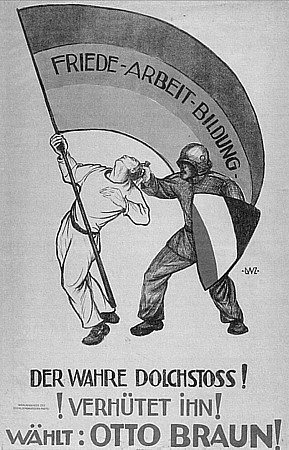
''Otto Braun, age 19, a volunteer who died in World War I, wrote in a letter to his parents: "My inmost yearning, my purest, though most secret flame, my deepest faith and my highest hope - they are still the same as ever, and they all bear one name: the State.
One day to build the State like a temple, rising up pure and strong, resting in its own weight, severe and sublime, but also serene like the gods and with bright halls glistening in the dancing brilliance of the sun - this, at bottom, is the end and goal of my aspirations.''Hegel's views are a fine example how volition, human free will, the essence of morality, is shifted from man to God, thus dodging human responsibility and lumbering God with the dire results of human free will.

 |
| - Left and Right Hegelians battling it out! - |
Continued from Part II: " Rousseau's Ravages"
 Often erroneously classified as part of the Enlightenment, Immanuel Kant (1724-1804) in his mindset is entirely antithetical to the values of that movement: he is a collectivist and is the inventor of subjectivism. His is not the mind of a scientist, but of a religionist.
The revered Kant is also a wee bit intellectually dishonest. His 'trick' was to stretch reason beyond the limits of what is reasonable and then used the outcome to discredit it. It culminated in his critique of "Pure Reason

"necessary to deny knowledge in order to make room for faith." ...These are hardly the words of a scientific thinker. Kant was an austere Lutheran Pietist and a great admirer of Rousseau. The individual to him represented little more than a miserable sinner in need of a strong master, only good as canon-fodder to teach some morals.
 .
 in "Explaining Postmodernism" makes a feminist analogy: to support Kant is to say that women are absolutely autonomous and free to do as they please, as long as it is within the confines of the kitchen; Kant imprisons the mind in the skull and isolates it from reality.
 " laments Kant's now codified idea-lism, ...
" ... the default declared position in academia and in nearly all other environments. Kant's success is partly explained by his tying his philosphical system to Newtonian physics [which he wanted to] have a certainty that it did not have. However, Kant thought that one could not know the thing itself
(...) Kant and Kantians múst say, "Kant doesn't know anything about anything." Such is always the end of the matter when one forgets that all knowledge in man comes through the senses. We non-Kantians can be simultaneously more accurate and kinder; we can say, "The foundational principles of Kant's philosophical system were wrong, but still he knew a lot of other things."This enthusiasm is at once tempered by a footnote:
"Many attribute to Kant a developed skill in physics. Physisist and renowned philosopher and historian of science, Fr. Stanley JakiWhat else is new in subjectivism?has shown that Kant's knowledge and ability in physics was minimal (though Kant considered himself another Newton) (...) the book [Universal Natural History
] is a storehouse of inaccuracies, contradictions and amateurism and plain fancy."
Continued from part I: "The Counter-Enlightenment"
Swiss-French philosopher Jean-Jacques Rousseau's (1712-1778) personal life is marked by traits sounding awkwardly contemporary. Self-pity and paranoia play see-saw with wrong choices and deflecting blame. Man is by nature good, it is society that is the cause of corruption and vice. Iconic for Rousseauian thought is the image of the noble savage, man in his natural state before his fall from Paradise.

 Common will" instead of freedom
 The Legacy
Reposted from March 3, 2008
The idea of the creation of a personalised universe, or rather a personal version of the universe originates with Protagoras (Πρωtaγόρaς, 490-420 BC), who said "man is the measure of all things", he meant individual man, rather than mankind.
The sophists of the rough, second generation, notably Trasymachus, a character in Plato's Republic, put that notion of subjectivism to good use. In classical Greece the sophists used language, not in the service of truth or the transfer of information, but as a strategy for political point-scoring. The sophists held that justice is in the interest of the stronger: might makes right.
Objectivist philosopher Stephen Hicks in "Explaining Postmodernism" claims that
"postmodernists - coming after two millennia of Christianity and two centuries of social theory - simply reverse that claim: Subjectivism and relativism are true, except that the postmodernists are on the side of the weaker and historically-oppressed groups. Justice, contrary to Trasymachus, is the interest of the weaker."
 The former began in England, and was picked up by the French. But Roussseau's followers wrested the Enlightenment inspired revolution away from John Locke's (1632 -1704) followers. This quote is from Locke's 2nd Treatise §3:
"In order to preserve the public good, the central function of government must be the protection of private property ..."... compare that to Rousseau:
"For the creation of a society of 'common will', the people need only accept the dictates of the state" ...The French Revolution turned it into the Jacobin Reign of Terror, the particularly bloody, third and last episode. The Germans thereafter, already suspicious of the culture of reason, began a counter movement in an effort to rescue religion from what they saw as the onslaught of reason. When the Enlightened French despot, Napoleon Bonaparte jumped into the vacuum left by the Reign of Terror and conquered Europe, the still largely feudal German states knew for sure what the age of reason had wrought.
"Accordingly, when the Left ran into its major disasters as the twentieth century progressed, understanding its fundamental commonality with the collectivist Right helps to explain why in its desperation the Left has often adopted ''Fascistic'' tactics."Another fateful innovation was set in by the counter movement. As had been the logic during the long period of Church authority over arts and science, all modern mainstream Enlightenment thinkers had accomodated the new advances in science and mathematics into Christian belief. Defying Aristotlean wisdom, human nature, as well as Hume's Law - the confusion of 'is' with 'ought' - the Counter-Enlightenment philosophers following Rousseau, Kant and Hegel - even the atheists - reversed this orthodoxy.
The Wilders trial has resumed and its aims and purposes have become apparent. There's precedent of course as well as the happy circumstance that Jordan and other Islamic countries are keeping mum for the duration of the trial. But the most important reasons are political and ideological.
The trial has haunted the election campaign, the election itself and finally also coalition talks between the conservative Liberal party VVD, the torn Christian Democrat party CDA and Wilders' own Freedom Party. At least four attempts to avert the historical right of center coalition have failed so far. The trial is the last ditch resort to render Wilders politically untouchable.
The President of the Court of Amsterdam, Jan Moors reminded me of Sméagol (or Gollem) of The Lord of the Rings, a hobbit who became so obsessed with the ring that enslaved him, that it corrupted him physically as well as mentally.
During yesterday's first regular session it didn't take long before Judge Moors made his first mistake. Defending council Moszkowicz had invoked the defendant's right to silence. Moors asked Wilders if this was the result of what some opponents have called his "tendency to posit tenets, but avoiding the debate". "It would seem you are doing that here AS WELL". The operative words being here 'as well'. Apparently the Judge shares that conviction.
The accusation is often levelled by opponents in the mainstream media, but also by Wilders' political Nemesis in Parliament, 'social liberal' party leader Alexander Pechtold. Moszkowicz started proceedings to have the Judges dismissed for being biased'. The Left haven't a clue how ideologically motivated their positions really are. To them, they are a model of neutrality.
Perhaps it's just a coincidence that the tribunal that will hear the allegation is presided over by a Judge who has seen to it that Pim Fortuyn's assassin will be back into society as early as May 6, 2014.


"It has been discerned from these emails that the indictment of my client has been discussed at the highest ministerial level. Moreover, this has been a political decision".The service doesn't think is strange at all. The Minister is politically responsible, so of course he was involved. Obviously these people are bending over backwards to prove there's still an independant judiciary in the Netherlands [/sarc]. They are the same people who maintain Wilders is a clear and present danger to the rule of law!
(...) the Left would rather see our entire civilization subsumed to the totalitarian "other"...than to acknowledge for one moment that a mere idea, multiculturalism, may have been a mistake.


