Pages

Showing posts with label France. Show all posts

Wednesday, December 8, 2010

Ideological Archeology: Rousseau's Ravages (II)

Continued from part I: "The Counter-Enlightenment"

Swiss-French philosopher Jean-Jacques Rousseau's (1712-1778) personal life is marked by traits sounding awkwardly contemporary. Self-pity and paranoia play see-saw with wrong choices and deflecting blame. Man is by nature good, it is society that is the cause of corruption and vice. Iconic for Rousseauian thought is the image of the noble savage, man in his natural state before his fall from Paradise.

There is nothing ambiguous about his ethics however: he believed his 'doctrine of two substances' to be the key to the absolute quality of good and evil [Jonathan I. Israel, Radical Enlightenment, 2001, p., 2001, p. 719]. In an example in a classical setting he saw in Athenian decadence the degrading influence of reason. He preferred the cruder, militaristic Spartans, an unspoiled and nobler tribe. Their callous practice of exposing babies to nature - now in dispute - may well have inspired Rousseau to expose his own five illegitimate children to the hardships of the Paris orphanage.

Although Rousseau died in 1778, before the French Revolution, his justification of violence to power was the source of inspiration of the Reign of Terror that the Jacobins unleashed during the latter part of the rebellion. In 1792 the French 'citizen army' faced the Prussian forces at Valmy. In a psychological victory they prevented them from marching on to Paris to restore the monarchy. Earlier in the capital a mob had stormed the Tuilleries Palace. In the massacres over a thousand political prisoners were brutally hacked to death. Fabre d'Eglantine declared: "In the towns, let the blood of traitors be the first Holocaust to Liberty, so that in advancing to meet the common enemy, we leave nothing behind to disquiet us!" [Wildmonk]

After "the first Holocaust to Liberty" many more would follow. It is a specific feature, typical of Rousseau's constellation of ideas. The chief ingredients as expressed in "Profession de Foi" are a sweeping rejection of tradition, Revelation, and all institutionalized authority. [Radical Enlightenment, p. 718]

In Roussea's ideas we find the source of every anti-Liberal, violent revolution ever since the French Revolution went off the Lockean track. Rousseau is ultimately the father of many noxious and lethal, collectivist traditions besides: Romanticism, redistributive Socialism, philosophical agrarianism, conservative Communitarianism, Nazism, and more to the point, the Counter-Enlightenment and postmodernism (including anti-human ecofascism). Cultures, adopting Rousseauian ideas found in them a mirror of some aspect of their own identity. [Wildmonk]

Many have descended into the abyss of collectivist hell. In France his radical egalitarianism led to The Reign of Terror, in Germany to Left and Right Socialism with known result, in Russia and the Far East to communism, starvation and slaughter on grandiose scales. In China Mao Tse Tung's Great Leap Forward resulted in the greatest mass murder in human history and in Cambodia the Khmer Rouge's extermination campaign to establish Rousseauian agrarianism resulted in the deaths of well over twenty percent of the population. [Wildmonk] If this is not evil, frankly I don't know what is.

Why Rousseau is different
Rousseau stands apart in many respects. He marks the fault-line in Western tradition between Anglo-American and Continental lines of thought, and forms the point of departure from the Enlightenment because he is essentially anti-modern [Wildmonk]. While loosely following the traditional path of Enlightenment thought, his radical stance differs notably on the crucial issues of anti-individualism [Isaiah Berlin, "Against the Current", 2001], anti-capitalism and against private property ("Radical Enlightenment", p. 273), anti science and technology, his radical egalitarianism, and the inherent mindset in which the means are justified by the perceived noble end.

Rousseau is often quoted as the iconic philosopher of the Enlightenment, but it is quite clear he fiercely rejected all its tenets and values. No doubt, here we have the ground zero of the Counter-Enlightenment.

He was certainly no believer in mutually beneficial interaction, or the beneficial effects on society of self-interest (Bernard Mandeville (1670-1733), "The Fable of the Bees"), asserting that "society hardly needs to feed man's love for himself and his desire to be first among men." ["Radical Enlightenment", p. 273].

His radical egalitianism is echoed in the notion that rational and industrious man with dehumanizing machines would replace royalty as an enslaver of the common man, being better and more ruthless on the aggregation of material goods. He argued that the separation of the progress and dissemination of science and art from political and religious control are hazardous for society and for the virtue of the people [Bloom, 1990]. But it gets worse."

Common will" instead of freedom
In Rousseau we see the first social contract at the price of freedom and the birth of a notion called the "common will". The latter is a concept that in Rousseau's approach requires state intervention. This should not be confused with the 'common good'. It is a far more developed conception which, and unlike the former, can only be realized in the context of civil society under the state ["Radical Enlightenment", p. 720).

For the creation of a society of common will, "freedom of all the people", they need only accept the dictates of the state. This was Rousseau's essence of "true civilization." The struggle between rich and poor would then rise to a moral experience of self-restraint. [Wildmonk] With the faculty of moral choice thus abdicated and forfeited to the state, people would be free from lowly - earthly desires and reach full - ideal potential. Man is thus divorced from the social and economic context in which he lives and interacts with others. The ideal state of heaven, separated from earthly considerations.

This totalitarian approach to freedom, an abomination in every sense, was later further developed by Marx, who wrote that "capitalist, individual liberty is the most complete suppression of all individual liberty and total subjugation of individuality to social conditions" [Wildmonk: Marx, "Grundnisse", pp. 131]. "Freedom can only consist in socialized man, the associated producers, rationally regulating their interchange with Nature, bringing it under their common control, instead of being ruled by it as by the blind forces of Nature; and achieving this with the least expenditure of energy and under conditions most favourable to, and worthy of their human nature." [Wildmonk: Marx, "Selected Writings", pp. 496].

In this way man's separation from his nature and morality began. Never in human history were their worse judges of human character than Rousseau and his followers: all seek some degree of formal control over individual freedom for the purpose of creating material conditions deemed necessary for "true freedom", moralectomy in precise equal measure. Rousseau's concept of "common will" became the most savage, bloody instrument of social engineering in the history of mankind.

The Atlantic Ridge
In the United States Thomas Jefferson was the most prominent supporter of the French revolutionary achievements. Nevertheless, property rights and Enlightenment liberties were set in stone in the spirit of Locke, Montesquieu and Adam Smith. The present Democratic Party is being diverted further and further from that tradition as the sway of the postmoderns intensifies. Rhetorical style and attitude betray their influence.

While National Socialist and Communist ideas have swept America to some extent in their haydays - notwithstanding the counter culture, a product of the latter - these Rousseauian inspired ideologies remained by and large a marginal affair. Rousseau entering Locke's territory by the back- door may come as a surprise to some Americans - the wrong brand of revolution is encroaching on its most basic principles.

In Europe the situation was markedly different, as we shall see. Locke's influence remained on the whole limited to the British Isles. France and Germany have both Rousseau traditions, not Lockean. Today of great long-term concern is a possible return to some form of Rousseau inspired extreme ideology. It is chilling to see the rise of an unelected governing body on the European continent. The post-democratic elitism, combined with postmodern ideological chaos understood in the philosophical context, is an even more disquieting prospect.

Counter-Enlightenment projection* is on the order of the day and may even be consciously used as a tactic. Rousseau's brand of radical and revolutionary ideas, combined with the notion that civilization is so corrupt that it must be considered beyond salvation, makes him the father of all violent struggle in the last two and a half centuries.

Americans, tending to confuse Locke's revolution with Rousseau's, occasionally fall into the trap of supporting the wrong causes: initially the Russian Red Terror, and more recently, the covertly Islam inspired call for independence in the middle of Europe's powder keg, the Serbian province of Kosovo in the heart of the Balkans, thus providing a foothold in Europe for similarly based and equally pernicious radicalism.

The zero-sum game approach to economics also originates with Rousseau, which is giving rise to the annual media talking point that "a new report is suggesting that today's rich are getting richer, and the poor are getting poorer". This is incorrect propaganda, some reason requiring regular public re-affirmation, perhaps for that reason alone.

Rousseau and Religion
The great minds of the Enlightenment proper - Spinozists excluded - never saw Christianity as their mortal enemy. To them Church and the Enlightenment were natural allies. Rousseau was no exception, but he had only a passing acquaintance with the Christian political tradition. Therefore he dismissed the role of Christianity as a moderating force in society. He saw the faith as entirely a spiritual undertaking, occupying itself only with "heavenly things."

Rousseau's Christians are so detached from reality that they can hardly be recognized: a people so spiritualized that they display a profound disinterest if their earthly pursuits are successful or not. Rousseau's call for transcendent values to harness the energies of men towards the 'common will', coupled with the rejection of Christianity as a engine of these values, made it a central tenet of all the Rousseauian ideologies [Wildmonk].

To Rousseau religion was an imperative. "... the state cannot ... pursue a policy of toleration for disbelievers, or view religion as a matter of individual conscience. It absolutely must, therefore, reject dangerous notions of toleration and the separation of church and state." and "so fundamentally important is religion that the ultimate penalty is appropriate for disbelievers ..." [Stephen R.C. Hicks, "Explaining Postmodernism", Scholargy Press, 2004, p. 98].

Despite being so enamored with force-feeding religion, after the publication of his work "Emile" he was driven into temporary exile in Bern after a warrant for his arrest was issued. "Emile" was widely denounced as irreligious and seditious.

The Legacy
The loather of civilization, Rousseau was nevertheless greatly admired by the early Counter-Enlighteners, as he is by today's postmodernists. His followers mostly selected from his work what they could use to prop up their ideologies. Marx accepted Rousseau's critique of Locke's economic man but stood solidly by the Enlightenment in his appreciation for science and technology. Marx even went so far as to describe his ideology as Scientific Marxism, basically a pseudo scientific rationalization of his aggregate of ideas.

Hegel as well as Rousseau inspired Marx' theory of dialectic materialism, in which the theme is the dichotomy of the Oppressor versus the Oppressed. Now clearly a tactic of this dialectic, Rousseau's vista of a noble, primordial world destroyed by man's egoism, might well also have sired the epidemic of Western self-loathing.

Irony
Ironically, while Rousseau was convinced that civilization was the cause of moral degradation, little did he know that his followers, by rejecting objective reality, would drop morality along with it. Despite two and a half centuries of genocidal legacy in pursuit of Rousseauian ideal society, it enjoys considerable support among the Western intelligentsia, specifically in the humanities departments of academia, the media, all levels of education, contemporary arts, the political elite, advisory boards, government ministries and departments and what is loosely described as 'the corridors of power.'

The postmodern heirs remain committed to undermining free-market democracy, casting misty eyes upon the Rousseauean atrocities. 110 million dead are not vile enough to discredit 'the Party of Humanity' in the views of some of the most stubborn apologists. Considering that totalitarian societies are today's version of the tribal community he so admired, the Rousseau ideal society could well be described as an agrarian totalitarian state.

Another point of irony is that Rousseau's conviction, that reason engenders egocentrism has been falsified by every non-government sponsored humanitarian organization on the face of the planet, while Rousseau's faithful follower Hegel is responsible for the subjectivism that saw the birth of egocentrism gone mad, the 'Master of the Universe' syndrome (each individual creates his own personal version of reality: If I die overnight, will the sun still rise tomorrow?).

In France, Rousseau's ideal of small, intimate villages and a peaceful, agricultural society built on the consent of the common will has resulted in France becoming a by-word for centralized statism. Rousseau's tenet that reason caused man's fall from paradise may well be the basis of the later Counter-Enlightenment's political ideals, modelled on the re-creation of 'paradise on earth', Utopias which usually turn out to be dystopias instead.

Postmodernism or Rousseauism?
Rousseau can certainly be traced back as the source of all members of the postmodern coalition: environmentalists, third-worldists (Baran-Wallerstein), feminists, anarchists, 'gender, identity and sexual orientation' theorists, traditional socialists of various plumage, and 'classical' postmodernists. It is a true gathering of Rousseauians that has largely remained uninvestigated, underreported and certainly undeclared.

In the chaos of the total postmodern bankruptcy in the wake of mayhem, moralectomy and grandiose failure, there is but one purpose left. A resolve that brings these ideologies together with a tradition with which it has so much in common. We are witnessing a spontaneous feast of recognition with radical Islam.

It is truly remarkable that every prior held conviction and allegiance has by now been jilted in favour of furthering the causes of the intolerant: it's back to the Rousseau basics. The grant plan: a strategy to deconstruct Western, democratic, liberal capitalism by critical theory, and 'irrational means of the will.'

Up next: Emmanuel Kant: "I found it necessary to deny knowledge in order to make room for faith."

If you think of yourself as a peaceful, loving person, while actually you are full of wrath and hatred, the psychological coping device of projection - as if by magic - transforms the object of that wratch into someone who is hateful, devisive, full of vitriol and bile, bigoted, intolerant and hatemongering.

Related dossiers


Wednesday, January 20, 2010

Haiti, the Battle Field of Two World Orders

Despite majestic bows to royal dinosaurs and august apologies for its existence, the world is not particularly impressed with President Obama's "unprecedented" and "historical" efforts to turn the US into a soft super power. The cultural divide between America and the rest of the world is still very much in evidence: American prowess confused with over-bearance, fortitude with hubris. Theater of operation, the earthquake stricken half-island state of Haiti where the US joint task force has taken charge of the airport.


The allegations are issued by the usual suspects: the accusation that the US is "using the relief effort as a pretext for occupation" by current political "mad man" of the Western hemisphere, Hugo Chavez will surprise no one; neither does the criticism emanating from the world of NGOs, home to a collective of anti American leftists of various hue.

But the French criticism is of a different order. The Minister in charge of Humanitarian Relief, Alain Joyandet was involved in a scuffle with the US Commander at the airport over a flight plan for a French evacuation mission. Which caused the intrepid plenipotentiary to exclaim in desperation:

"This is about helping Haiti, not about occupying Haiti."


The spat lays bare a much more profound division between America and the rest of the world. The US is stuck in international principles governed by the Peace of Westphalia, which laid the basis for the post feudal world order through the concept of the sovereign state. And whereas American exceptionalism sees its own zeal for liberty solely as a power for the good, the rest of the world is not so sure.

The new, transnational progressive world order seeks to eliminate the sovereign state as an immoral remnant of the old, evil, post Westphalian order. It is reigned by peace through perpetual parley, interconnectedness, mutual dependency, multilateralism, and that arbiter of postmodern truth, consensus.

Perhaps Monsieur Joyandet would like to propose a venue for talks to "clarify" the US role, until UN headquarters in Haiti has sufficiently recovered from its devastation to take charge of the relief coordination?

An even less flattering take on the French critique is also thinkable. France held the colony of Haiti from 1697 to 1804. Perhaps there is still something smoldering in the French national psyche that likes to think of itself as the island's prime mover?

There may well come a time when the US will say, enough is enough and withdraw in splendid isolation to the glorious lands between the shining seas, leaving the ever scathing world to fend for itself. What will the charges then be: unconscionable selfishness, or americano-centrism?

Recommended:

The Washington Times: "The upside of Yankee imperialism in Haiti"

Related:

- "Transnational Progressivism" (dossier)
- NRC: "Americans 'occupy' Haiti"

Reblog this post [with Zemanta]

Saturday, September 19, 2009

Weekend Movie: The Fate of Saddam's Pride and Joy


In The Lighthouse Movie Theater today a story from way, way back when the grown-ups were in charge: "Israel's Raid on Saddam's Nuclear Reactor in 1981"

Saturday, January 17, 2009

The Burning Streets: How We Got Here

Seldom was an assumption as naive as the idea prevailing since 1989 that political radicalism was over, just because the major agitator - the Soviet Union - had collapsed under its own weight.

This notion in the heads of security services, politicians and the general public supports the evidence that the West swallowed Communist disinformation and propaganda, hook, line and sinker. Here's one that pervades Western popular thinking to this very day.

Also on the level of ideas 'Leftism' and its origins, has been very badly understood.

The first harbinger of a better understanding was posited by philosopher and historian Sir Isaiah Berlin who coined the term, the Counter-Enlightenment in his book "Against the Current" in 1979 (Hogarth Press). In all probability this trouveille can be attributed to Nietzsche, who used the term "die Gegenaufklärung" at the end of the nineteenth century.

Objectivist philosopher Stephen Hicks has explained the origins and history of the anti-modern Counter-Enlightenment movement very succinctly in his 2004 tome "Explaining Postmodernism: Skepticism and Socialism from Rousseau to Foucault".

More recently Richard Wolin in "The Seduction of Unreason: The Intellectual Romance with Fascism from Nietzsche to Postmodernism" bridged the gap even further, showing how an amalgam of Left and Right collectivism resurfaced in Postmodernism. (Here's a sample chapter available from Princeton University Press.)

The reactionary movement sought to counter and destroy the rational and humanistic ideals of the Enlightenment, modernism. The first anti-modernist is the erroneously classified hero of the Enlightenment, Jean-Jacques Rousseau. He broke with reason and individualism, in effect laying the groundwork for Socialism and the notion that a collective has a 'will' of its own.

After Rousseau, the influential anti-philosophers Kant and Hegel furthered the anti-modernist cause against reason. Kant was remarkably effective in isolating the mind within the confines of the skull, rendering it practically useless as a tool for exploring knowledge and the universe. Precursing Orwell, he typified it as Pure Reason.

- Caption: Legion Park, Brighton Heights, Pittsburgh, center piece of the World War I Memorial by Allen G. Newman - photo by artisticpursuits -

From Kant onwards, the avant-garde considered man incapable of knowing anything. Kant's irrational theories are the greatest disaster in the history of the post Renaissance world. They are responsible for all pernicious ideas about the nature of thought that persist to this day.

It opened up the field for Marxism (Left collectivism), National Socialism (Right collectivism), currently culminating in Postmodernism. The latter think of the human species as a whole as a collective, a idea of Kantian origin.

Humanity as a collective is pushed today by swathes of world elites, from the transnational "one world" movement, to multiculturalists and Postmodern anti-globalists.

The Greeks identify the latter by their proper name, anarchists. The rest of the W est knows them as the squatter movement, animal rights activists, radical environmentalists, and anti globalists. They are not anti globalism as such, but just anti Western dominated globalism.

After Left and Right collectivism were dealt with through the realities of history and Francis Fukuyama briefly enjoyed "The End of History and the Last Man" the storms of Islamic radicalism were already brewing in the Middle East and spilling over on the streets of the countries favored by Muslim migrants.

The onset of the 21st Century saw a revival of Leftist radicalism. While the old 1968 hippy generation saw it's ideals drowned in a cesspool of drugs and experiments in social licentiousness, Postmodernism has shed itself of all values: life is futile, man's efforts are absurd in their presumptiousness and arrogance.

This radical Left movement is just as ready for a scorched earth as radical Islamism is. Whereas the former have nothing left to lose after their ideals collapsed over their ears, the latter are urged to self-sacrifice for a global victory of the collective Ummah. It is a marriage quite literally made in hell: both are negators of the life-force, but for different reasons.

A culture's implicit sense of life is all-pervasive. Theirs has translated into the negative territory of nihilism and death-worship. For Muslims man is a mere plaything in the hands of a fickle God. To Postmodernists man is a drifter in a purposeless, unknowable universe whose fate is determined by chaos and glandular secretions.

And this is how we got here.

World Security Network: "Urban Radicalism in Europe and Terrorism", by Ioannis Michaletos

Urban radicalism in Europe as portrayed by the recent riots in Athens is a constant worry of the European security services, since there is ample evidence of wider connections between radicals and terrorists.

There are two major themes to be looked upon. Firstly the relationship between the extreme-leftist terrorist groups that operate in the so-called "Mediterranean axis" - France, Italy, Greece and Spain - and secondly, the connection of these groups to Islamic extremists.

The radical - anarchist movement in Europe is pretty strong and well organized with thousands of loyal supporters. Back in 2005, the riots in Paris proved that the radicals and second-generation Muslim immigrants in France were able to form the political agenda of that time, although they were not successful in preventing Sarkozy’s ascendance to power 18 months later.

In June 2008, the French authorities and in particular the Direction générale de la sécurité extérieure (French Directorate-General for External Security or DGSE) announced that French anarchists were behind the attempted sabotage of the TGV railway, that if successful could have killed hundreds of people. It was also revealed that the anarchist group labeled "The Invisible Committeel" was in contact with other Italian and Greek groups over the previous period. (...)

Get it all, read the latest revelations by Greek intelligence analyst Ioannis Michaletos >>>

- Filed on Articles in "The Unholy Alliance" -

Tuesday, December 9, 2008

Riots in Greece: What Is Not Reported

From the desk of Ioannis Michaletos

~~-:-~~

The International Analyst Network website has as a main aim to inform a specialized and enlightened audience of the undercover nature of events within the global security and intelligence sector.

In this case, an alternative point of view is going to be presented which derives from careful analysis and observation of the riots in Greece and reliable information streaming from domestic security circles. For obvious reasons, matters concerning operational or intelligence procedures will not be mentioned or quoted.

The riots have been orchestrated since late summer 2008. There were reports within the Greek police that the riots would commence by the Christmas period at the latest; the location and the justification was not known, but any event could have caused them. This is a copycat case of what happened in France in October 2005.

The culprits on the higher levels are Islamic networks in the Middle East, who go hand-in-hand with corrupt western officials, who are selling their services to the highest bidder.

The purpose is to destabilize Greece, the “weakest link” in the Euro zone countries. The ultimate goal is the creation of a European space, suitable for expansion of the Middle Eastern networks. For the moment the latter use a variety of techniques to bolster their aims: terrorism, disinformation, psyops, bribing officials.

They are trying to pit the US against Russia on the one hand, and to disrupt the Euro-American alliance on the other. They were also responsible for the Greek wildfires (pyro terrorism) in summer 2007 in an operation some call “the Ibrahim Project”, reminiscent of the type of havoc wreaked on the same region by Ibrahim Pasha of Egypt during the Greek revolution in the summer of 1827.

The existence of more than obvious links between renegade intelligence officers of western origin and anarchist-radical movements, in order to destabilize European countries is a major issue nowadays.

The anarchist-radical network of disenfranchised youths is very strong in Europe as the riots in 2005 showed, when radicals and Muslims joined forces and failed to damage French President Sarkozy’s image. In France it was announced recently by the Ministry of Interior that French anarchists are in contact with their Greek and Italian counterparts in trying to sabotage the High Speed Railway Network (TGV trains).

The inability of western governments to comprehend what is really at stake has already grave consequences for Europe. Moreover, the deals between European and Russian energy companies will increase natural gas imports by the former, will greatly diminish the influence of the Saudis in Europe, along with their long-term income.

The new American administration should really understand that it has been used for a number of years by Riyad (and others) who have managed to throw American forces into the Iraqi and Afghan battlefields, where the new 21st century Mujahedeen forces are being forged. They will be used against Europe in a few years, in a wargame that will surpass the abilities of Western capitals.

Back in Greece the riots are being executed with the use of the Internet and other new media techniques, such as instant messaging (IM) from mobile phones to web pages, Indymedia, along with the use of CB’s, Facebook pages, walkie-talkies, computer mass generated SMS, Twitter, and the construction of “flow-networks” and already established “dark networks” within the city.

The French government has already called for tough action by the Greek administration, whilst the intelligence apparatus of the former provides assistance to the latter. Over the coming days it seems that all the known security forces in the world will either try to take advantage of the situation, or take the side of the Greek government.

In a concluding remark, the author emphatically notes that the responsibility of the western capitals is of historical proportions. Rioting by “radical youths” will become an everyday reality on the continent in the coming years and the security forces should look further than their noses in assessing the situation.

A 4th World War erupted in 2001 and there are enemy collaborators within our ranks. Before any victory can be called, they should be removed and punished accordingly. The riots in Greece are just one small incident in the ongoing war, that may last longer than the previous ones; it is a struggle which all-encompasses national, social, and economic structures.

Interested readers should not forget that the first “Little War” of the Cold War started on Greek soil in 1946. Back then the enemy was clear and present. Now he is not, and the effort therefore will be much harder.

Post Scriptum: Quite a few Greek radical groups have adopted Arabic noms de guerres; they promote illegal immigration of Muslims into Europe, and call for the destruction of Western civilization. They are part of an almost global network that acts as a “soft power” element of the hard one, as envisaged by Al Qaeda. It has to be stressed once more that rogue elements of western security forces protect them. They have to be dealt with as soon as possible.


- Filed on Articles in "Terrorism in Greece" -

Tuesday, March 4, 2008

Radical Rousseau's Ravages

Swiss-French philosopher Jean-Jacques Rousseau's (1712-1778) personal life is marked by traits sounding awkwardly contemporary. Self-pity and paranoia play see-saw with wrong choices and deflecting blame. Man is by nature good, it is society that is the cause of corruption and vice. Iconic for Rousseauian thought is the image of the noble savage, man in his natural state before his fall from Paradise.

There is nothing ambiguous about his ethics however: he believed his 'doctrine of two substances' to be the key to the absolute quality of good and evil [Jonathan I. Israel, Radical Enlightenment, 2001, p., 2001, p. 719]. In an example in a classical setting he saw in Athenian decadence the degrading influence of reason. He preferred the cruder, militaristic Spartans, an unspoiled and nobler tribe. Their callous practice of exposing babies to nature - now in dispute - may well have inspired Rousseau to expose his own five illegitimate children to the hardships of the Paris orphanage.

Although Rousseau died in 1778, before the French Revolution, his justification of violence to power was the source of inspiration of the Reign of Terror that the Jacobins unleashed during the latter part of the rebellion. In 1792 the French 'citizen army' faced the Prussian forces at Valmy. In a psychological victory they prevented them from marching on to Paris to restore the monarchy. Earlier in the capital a mob had stormed the Tuilleries Palace. In the massacres over a thousand political prisoners were brutally hacked to death. Fabre d'Eglantine declared: "In the towns, let the blood of traitors be the first Holocaust to Liberty, so that in advancing to meet the common enemy, we leave nothing behind to disquiet us!" [Wildmonk]

After "the first Holocaust to Liberty" many more would follow. It is a specific feature, typical of Rousseau's constellation of ideas. The chief ingredients as expressed in "Profession de Foi" are a sweeping rejection of tradition, Revelation, and all institutionalized authority. [Radical Enlightenment, p. 718]

In Roussea's ideas we find the source of every anti-Liberal, violent revolution ever since the French Revolution went off the Lockean track. Rousseau is ultimately the father of many noxious and lethal traditions besides: Romanticism, redistributive Socialism, philosophical agrarianism, conservative Communitarianism, Nazism, and more to the point, the Counter-Enlightenment and postmodernism. Cultures, adopting Rousseauian ideas found in them a mirror of some aspect of their own identity. [Wildmonk]

Many have descended into the abyss of collectivist hell. In France his radical egalitarianism led to The Reign of Terror, in Germany to Left and Right Socialism with known result, in Russia and the Far East to communism, starvation and slaughter on grandiose scales. In China Mao Tse Tung's Great Leap Forward resulted in the greatest mass murder in human history and in Cambodia the Khmer Rouge's extermination campaign to establish Rousseauian agrarianism resulted in the deaths of well over twenty percent of the population. [Wildmonk] If this is not evil, frankly I don't know what is.

Why Rousseau is different
Rousseau stands apart in many respects. He marks the fault-line in Western tradition between Anglo-American and Continental lines of thought, and forms the point of departure from the Enlightenment because he is essentially anti-modern [Wildmonk]. While loosely following the traditional path of Enlightenment thought, his radical stance differs notably on the crucial issues of anti-individualism [Isaiah Berlin, "Against the Current", 2001], anti-capitalism and against private property ("Radical Enlightenment", p. 273), anti science and technology, his radical egalitarianism, and the inherent mindset in which the means are justified by the perceived noble end.

Rousseau is often quoted as the iconic philosopher of the Enlightenment, but it is quite clear he fiercely rejected all its tenets and values. No doubt, here we have the ground zero of the Counter-Enlightenment.

He was certainly no believer in mutually beneficial interaction, or the beneficial effects on society of self-interest (Bernard Mandeville (1670-1733), "The Fable of the Bees"), asserting that "society hardly needs to feed man's love for himself and his desire to be first among men." ["Radical Enlightenment", p. 273].

His radical egalitianism is echoed in the notion that rational and industrious man with dehumanizing machines would replace royalty as an enslaver of the common man, being better and more ruthless on the aggregation of material goods. He argued that the separation of the progress and dissemination of science and art from political and religious control are hazardous for society and for the virtue of the people [Bloom, 1990]. But it gets worse.

"Common will" instead of freedom
In Rousseau we see the first social contract at the price of freedom and the birth of a notion called the "common will". The latter is a concept that in Rousseau's approach requires state intervention. This should not be confused with the 'common good'. It is a far more developed conception which, and unlike the former, can only be realized in the context of civil society under the state ["Radical Enlightenment", p. 720).

For the creation of a society of common will, "freedom of all the people", they need only accept the dictates of the state. This was Rousseau's essence of "true civilization." The struggle between rich and poor would then rise to a moral experience of self-restraint. [Wildmonk] With the faculty of moral choice thus abdicated and forfeited to the state, people would be free from lowly - earthly desires and reach full - ideal potential. Man is thus divorced from the social and economic context in which he lives and interacts with others. The ideal state of heaven, separated from earthly considerations.

This totalitarian approach to freedom, an abomination in every sense, was later further developed by Marx, who wrote that "capitalist, individual liberty is the most complete suppression of all individual liberty and total subjugation of individuality to social conditions" [Wildmonk: Marx, "Grundnisse", pp. 131]. "Freedom can only consist in socialized man, the associated producers, rationally regulating their interchange with Nature, bringing it under their common control, instead of being ruled by it as by the blind forces of Nature; and achieving this with the least expenditure of energy and under conditions most favourable to, and worthy of their human nature." [Wildmonk: Marx, "Selected Writings", pp. 496].

In this way man's separation from his nature and morality began. Never in human history were their worse judges of human character than Rousseau and his followers: all seek some degree of formal control over individual freedom for the purpose of creating material conditions deemed necessary for "true freedom", moralectomy in precise equal measure. Rousseau's concept of "common will" became the most savage, bloody instrument of social engineering in the history of mankind.

The Atlantic Ridge
In the United States Thomas Jefferson was the most prominent supporter of the French revolutionary achievements. Nevertheless, property rights and Enlightenment liberties were set in stone in the spirit of Locke, Montesquieu and Adam Smith. The present Democratic Party is being diverted further and further from that tradition as the sway of the postmoderns intensifies. Rhetorical style and attitude betray their influence.

While National Socialist and Communist ideas have swept America to some extent in their haydays - notwithstanding the counter culture, a product of the latter - these Rousseauian inspired ideologies remained by and large a marginal affair. Rousseau entering Locke's territory by the back- door may come as a surprise to some Americans - the wrong brand of revolution is encroaching on its most basic principles.

In Europe the situation was markedly different, as we shall see. Locke's influence remained on the whole limited to the British Isles. France and Germany have both Rousseau traditions, not Lockean. Today of great long-term concern is a possible return to some form of Rousseau inspired extreme ideology. It is chilling to see the rise of an unelected governing body on the European continent. The post-democratic elitism, combined with postmodern ideological chaos understood in the philosophical context, is an even more disquieting prospect.

Counter-Enlightenment projection* is on the order of the day and may even be consciously used as a tactic. Rousseau's brand of radical and revolutionary ideas, combined with the notion that civilization is so corrupt that it must be considered beyond salvation, makes him the father of all violent struggle in the last two and a half centuries.

Americans, tending to confuse Locke's revolution with Rousseau's, occasionally fall into the trap of supporting the wrong causes: initially the Russian Red Terror, and more recently, the covertly Islam inspired call for independence in the middle of Europe's powder keg, the Serbian province of Kosovo in the heart of the Balkans, thus providing a foothold in Europe for similarly based and equally pernicious radicalism.

The zero-sum game approach to economics also originates with Rousseau, which is giving rise to the annual media talking point that "a new report is suggesting that today's rich are getting richer, and the poor are getting poorer". This is incorrect propaganda, some reason requiring regular public re-affirmation, perhaps for that reason alone.

Rousseau and Religion
The great minds of the Enlightenment proper - Spinozists excluded - never saw Christianity as their mortal enemy. To them Church and the Enlightenment were natural allies. Rousseau was no exception, but he had only a passing acquaintance with the Christian political tradition. Therefore he dismissed the role of Christianity as a moderating force in society. He saw the faith as entirely a spiritual undertaking, occupying itself only with "heavenly things."

Rousseau's Christians are so detached from reality that they can hardly be recognized: a people so spiritualized that they display a profound disinterest if their earthly pursuits are successful or not. Rousseau's call for transcendent values to harness the energies of men towards the 'common will', coupled with the rejection of Christianity as a engine of these values, made it a central tenet of all the Rousseauian ideologies [Wildmonk].

To Rousseau religion was an imperative. "... the state cannot ... pursue a policy of toleration for disbelievers, or view religion as a matter of individual conscience. It absolutely must, therefore, reject dangerous notions of toleration and the separation of church and state." and "so fundamentally important is religion that the ultimate penalty is appropriate for disbelievers ..." [Stephen R.C. Hicks, "Explaining Postmodernism", Scholargy Press, 2004, p. 98].

Despite being so enamored with force-feeding religion, after the publication of his work "Emile" he was driven into temporary exile in Bern after a warrant for his arrest was issued. "Emile" was widely denounced as irreligious and seditious.

The Legacy
The loather of civilization Rousseau was nevertheless greatly admired by the early Counter-Enlighteners, as he is by today's postmoderns. His followers mostly selected from his work what they could use to prop up their ideologies. Marx accepted Rousseau's critique of Locke's economic man but stood solidly by the Enlightenment in his appreciation for science and technology. Marx even went so far as to describe his ideology as Scientific Marxism, basically a pseudo scientific rationalization of his aggregate of ideas.

Hegel as well as Rousseau inspired Marx' theory of dialectic materialism, in which the theme is the dichotomy of the Oppressor versus the Oppressed. Now clearly a tactic of this dialectic, Rousseau's vista of a noble, primordial world destroyed by man's egoism, might well also have sired the epidemic of Western self-loathing.

Irony
Ironically, while Rousseau was convinced that civilization was the cause of moral degradation, little did he know that his followers, by rejecting objective reality, would drop morality along with it. Despite two and a half centuries of genocidal legacy in pursuit of Rousseauian ideal society it enjoys considerable support among the Western intelligentsia, specifically in the humanities departments of academia, the media, all levels of education, contemporary arts, the political elite, advisory boards, government ministries and departments and what is loosely described as 'the corridors of power.'

The postmodern heirs remain committed to undermining free-market democracy, casting misty eyes upon the Rousseauean atrocities. 110 million dead are not vile enough to discredit 'the Party of Humanity' in the views of some of the most stubborn apologists. Considering that totalitarian societies are today's version of the tribal community he so admired, the Rousseau ideal society could well be described as an agrarian totalitarian state.

Another point of irony is that Rousseau's conviction, that reason engenders egocentrism has been falsified by every non-government sponsored humanitarian organization on the face of the planet, while Rousseau's faithful follower Hegel is responsible for the subjectivism that saw the birth of egocentrism gone mad, the 'Master of the Universe' syndrome (each individual creates his own personal version of reality: If I die overnight, will the sun still rise tomorrow?).

In France, Rousseau's ideal of small, intimate villages and a peaceful, agricultural society built on the consent of the common will has resulted in France becoming a by-word for centralized statism. Rousseau's tenet that reason caused man's fall from paradise may well be the basis of the later Counter-Enlightenment's political ideals, modelled on the re-creation of 'paradise on earth', Utopias which usually turn out to be dystopias instead.

Postmodernism or Rousseauism?
Rousseau can certainly be traced back as the source of all members of the postmodern coalition: environmentalists, third-worldists (Baran-Wallerstein), feminists, anarchists, 'gender, identity and sexual orientation' theorists, traditional socialists of various plumage, and 'classical' postmoderns. It is a true gathering of Rousseauians that has largely remained uninvestigated, underreported and certainly undeclared.

In the chaos of the total postmodern bankruptcy in the wake of mayhem, moralectomy and grandiose failure, there is but one purpose left. A resolve that brings these ideologies together with a tradition with which it has so much in common. We are witnessing a spontaneous feast of recognition with radical Islam.

It is truly remarkable that every prior held conviction and allegiance has by now been jilted in favour of furthering the causes of the intolerant: it's back to the Rousseau basics. The grant plan: a strategy to deconstruct Western, democratic, liberal capitalism by critical theory, and 'irrational means of the will.'

* If you think of yourself as a peaceful, loving person, while actually you are full of wrath and hatred, the psychological coping device of projection - as if by magic - transforms the object of that wratch into someone who is hateful, devisive, full of vitriol and bile, bigoted, intolerant and hatemongering.

- Filed on Articles in "The Dystopia of Paradise", cat. Postmodernism (Sundry) -

Monday, February 18, 2008

What is never said...

Here's what you can hear these days, six years after September 11: "The US President, through his war in Iraq against Islamic totalitarianism, radicalized the Muslim world and weakened the Western world. Incidentally, France predicted that." Nice.

But then, how come that Jacques Chirac has already fallen into oblivion? It's not him but Tony Blair, who left power not long after him, who has been appointed as mediator in the Near-East. Maybe our leaders believe that "George Bush's poodle" knows it better, right?

The angelic view says that terrorism is the expression of poverty and humiliation. This cliché forgets about the jihad fought against Western world and its way of life, in the name of a conquest and submission ideology. Some months ago, Osama Bin Laden invited Americans to join Islam while Al-Qaida attacked twice disobedient Algeria. Hatred leads Muslims into murdering other Muslims ...

But this time, victims were reacting. Algerians demonstrated in the streets, saying clearly "No to violence." On the same day in Gaza, a general strike took place to protest against the violent politics of Hamas. In Iraq, a poll showed that citizen consider Al Qaida to be the main cause of violence (21%), before USA (19%) and Iran (11%)

Nazislamism, fought by Bush and Blair, is beginning to be rejected by Muslims who feel dishonored by its barbary. In the al-Anbar province (Iraq) Sunnite militia are now collaborating with Americans. In Iran, Ahmadinejad is considered a disgrace for part of the population. In Morocco, even the so called "moderate islamists" didn't do good in the last election.

One wonders if it would be the case if pacifist France had been followed, France which advocated status-quo in Iraq and didn't want to hear about a war against terrorism? USA's strategy can't be summed up in the chaos that medias love to describe. Pointing his finger at the enemy, Bush has been awakening the Free World's vigilance. THAT'S WHAT IS NEVER SAID.

Some kind of contempt towards Arab-Muslim world leads to think that it can only understand the voice of tyranny. In essence, it's the argument of the Leftist intelligentsia who condemn Bush for willing to free Iraq of its pseudo-secular dictatorship. When hearing them, you get the feeling that Saddam Hussein should have been left free to terrorize its people.

Actually, even if Americans blew up Iraq's occupation with their unpreparedness and certitude, they nonetheless clarified the stake, showing that the cultures clash is between submission and freedom rather than between Arabs and Westerners.

Yes, it was naive to think that democracy would prevail in Baghdad and then spread in the neighbouring countries. But it's still reachable and many Iraqis hope to consolidate it. "We are building the bases of a new democracy" explains Hohyar Zebari, Foreign Affairs Minister. Still, many so-called specialists go on incriminating USA and this position makes Bin Laden master of the game. This kind of "surrender" only satisfies islamists.

The free world can't afford to give a hand to its enemies. Now, radical Islam takes advantage of this confusion to try and establish itself in Europe. In Germany, two converts were on the verge of committing suicide attacks. The Jewish community in this country must be concerned with the rise of this new antisemitism initiated by hatred preachers.

Not long ago in the Netherlands, ex-Muslims decided to denounce politic Islam. "We are breaking the taboo coming with abjuration of Islam, but we also take the party of reason, rights and universal values as well as secularism" they wrote in their "European declaration for tolerance." In France also, many secular Muslims have adapted to the rules and way of life of Western society. We must support these democrats.

These days as we see Belgium tearing apart between Dutch-speaking Flanders and French-speaking Wallonia reminds us how fragile a nation is when it's no more welded by a shared identity. In the heart of Europe, this country could well explode because two communities, however born of the same Christian culture, don't feel interdependent anymore.

That's why a country like France must consolidate the national feeling which is essential to its unity, while immigration upsets its demography. The greater Paris (Ile-de-France) accounts for 19% of French population and contributes for 43% of the population's growing, just because of the fecundity of African or North African immigration. Will France always be able to inspire this overly Muslim population with its Western values? It's only possible through fighting the pressure of radical Islam.

(Based on an article by Ivan Rioufol, editor of "Le Figaro" and Senior Fellow at the Atlantis Institute)

Monday, February 4, 2008

It Takes More Than a Bitch to Make a President ...

I have a vivid memory of Sunday January 14, 2007. On that day I watched Nicolas Sarkozy do his speech as the new UMP nominated candidate for the Presidential Election. This speech was outstanding. I had it printed afterwards and read it again and again, always with emotion, with tears in my eyes.

He was saying how "Gaullism was not a doctrine because general De Gaulle never wanted that, but was a moral commitment, exercising power as a mission devoting oneself one hundred percent, the conviction that France is strong only when united, the certitude that nothing is lost till the Resistance spark is alive in the heart of only one man, the refusal to quit, rupture with set ideas and established "order" when those lead France towards decline"

Nicolas Sarkozy was a fantastic hope that day for European society. A leader was born! But today my disillusion measures up to this incredible hope: I'm p#sd off, I feel cheated, outraged. His words were just words, this guy is just a liar. He pretended to be the champion of work, ethics, morale, dedication, a family defender, the man who would bring back confidence for the honest citizen.

Now, look at him: he's the exact opposite. The only side of him we have seen since September is his very much restless private life. If people can stand a divorce, his love affair with sex-symbol Carla Bruni-Tedeschi is frightening.

Nicolas Sarkozy is President no more, he is just a pitiful quinquagenarian unable to put his demons at rest, marrying a woman he has been dating for two months. Showing through his choice that his speech about traditional values is just bs: Carla Bruni-Tedeschi is very well known to be a Leftist with very large ideas about behaviour and living standards, I mean she's sub-zero as far as moral values are concerned.

All her life she's been a real highway for male-riders, defining herself much more polygamous than monogamous. She had love affairs with half the show-business, for instance Eric Clapton, Mick Jagger, Vincent Perez, but also with Donald Trump and even... former French Prime Minister Laurent Fabius, a socialist rival of her now husband Nicolas Sarkozy.

She's a woman able to leave a man for his son (philosopher - oh my Gooood- Raphaêl Enthoven) and to have a child with him. Lately, she posed in the nude for a Spanish paper, wearing the ring she received as a present from Sarkozy.

As stated by the International Herald Tribune, Sarkozy's witness at the wedding was Nicolas Bazire, a senior figure in the LVMH Moët Hennessy Louis Vuitton luxury goods group, while Bruni's witness was Mathilde Agostinelli, head of communications at Prada France.

And that shows another side of Sarkozy, his vulgar and ostentatious manners. Is it appropriate to have superficial companies like Prada and Louis Vuitton represent the symbol of his wedding. What about the people he represents?

Let's face it: from the moment he went into Office, Sarkozy, rather than being noticed for his work and his reforms, has shown his interest for rich and powerful friends who are willing to place their yachts, aircrafts, houses at his disposal (with privileges in return?), for expensive and superficial clothes or accessories like watches (how stupid can an expensive watch collecting man be?) and for easy women.

We know everything about the woman he dates/marries, everything about the clothes he buys, everything about his frequent holidays, yet very little about the measures he takes to bring France back on the rails.

We can see him wandering with Bruni in the streets of Paris, in Egypt, in Disneyland, everywhere. Does the guy work? The media frenzy has dealt a blow to Sarkozy's popularity ratings, with French voters complaining that he was concentrating too much on his personal life and not enough on the affairs of the country...

Trouble has surfaced over this side of the "President bling-bling", as they call him, a "leader" fixated as much on foreign holidays and pretty women as on the need for boosting French GDP.

Can a lovestruck President enact the reforms his country desperately needs? It also did not help that these holidays came at a time when ordinary people were grumbling about rising heating costs and a dramatic decline in the purchasing power of their euros. President Sarkozy is now busy with his love affair with a dubious woman, not with his work: he should resign.

This somehow remembers me the story of Urbino, a beloved city for me: in 1444, Oddantonio da Montefeltro, recently named Duke of Urbino, spoiled the cashes of the small state with his excessive life-style (he is reported to have held parties during more than 15 days), and had to exert heavy taxes over the duchy. He also sought support with their arch-enemies, the Malatesta, seemingly reaching a complete dependence from them.

As a result, in the night between 21 and 22 July of 1444 he was killed by conjurers in the Ducal Palace and thrown through the window crashing at the feet of his angry citizens. Okay, we are civilized now: come on French people, let's force Sarkozy into resignation and let's let him walk away alive through the door of the Elysée.

Monday, January 7, 2008

Mohamed ElBaradei: Useful Idiot or Trojan Horse?

Mohamed ElBaradei, director general of IAEA, keeps saying over and over again what Washington doesn't want to hear: "There is no proof that Iran tries to acquire atomic weapons." And a few weeks ago, a new U.S. National Intelligence Estimate seemed to confirm that there is no proof of on-going nuclear weapons program in Iran since the fall of 2003.

In his Vienna apartment, ElBaradei accepted an interview by the French weekly magazine Paris-Match. Here are a few excerpts and comments:

Paris-Match: A new U.S. National Intelligence Estimate concluded that there had been no on-going nuclear weapons program in Iran since the fall of 2003? Is it a victory for you?

ElBaradei: It's a nice Christmas gift! We have some concerns about the Iranian nuclear program but this doesn't mean that Iran is a impending threat. And this doesn't mean that we have proof that Iran tries to acquire nuclear weapons. This report gives diplomacy new opportunities. We need to stop the war logic.

My comments: And you implicitly admit that you have no sure proof that Iran does NOT try to acquire nuclear weapons, Mr ElB ...

P-M: Is Iran threatening world peace?

ElB: In the short term I would say, no. In the long term, it's different. Several countries don't trust Iranian leaders.

My comments: Tell me, Mr ELB, what do you think? Are they trustworthy? What does it mean: "in the long-term it's different"?

P-M: After this NIE report, there'll be no American raid against Iran?

ElB: I hope so. A raid against Iran would have negative effects. This would solve no problem. First, Iranians have no big nuclear infrastructure. Destroying it would only delay their program for a few months. Then they would restart their nuclear activities in a clandestine way. And let's speak about the consequences in the region! The Muslim world is angry, feels humiliated. A war would draw further extremism.

My comments: So when activities are clandestine, it's though to detect it, right? Give me some proof that part of the program isn't clandestine already. And, oh Mr ElB, I forgot: you are yourself a Muslim with a biased view. Stop it with this leitmotiv of the angry and humiliated people. Humiliated by whom? Their own leaders, their own sick society based on a fascist religion.

P-M: France, amongst other countries want new sanctions against Iran. What is your position about that?

ElB: These countries are free to take this position, even if I have my ideas on the question. I'm pretty sure about one thing: without negotiations, there'll be no long-lasting solution. The Iranian nuclear problem is only part of a complex situation involving the Middle East and Muslim world security. To establish confidence between parts, you have to talk about Iraq, Afghanistan, Palestine, Lebanon, you have to talk about extremism, human rights, poverty. Many people in this region have to live on less than two dollars a day. Is this acceptable? This people' ll become extremists. Because they have nothing to loose, because they feel humiliated.

My comments: READ: "by negotiations, I mean that the Western world has to honor every demand of the Muslim world." And Mr ElB, yes lets talk about poverty. 2 dollars a day? Unacceptable! Especially when you realize that these people are sailing on a sea of oil! So give us a break : there is more than enough money within the Muslim world to solve the poverty problems. The western world? It does more than enough, buying your oil. The truth is: YOUR world, Mr ElB, should feel ASHAMED, not only humiliated. And after all, what's your job? You're the director general of IAEA, you're not supposed to do politics. And as we speak about your function, I would have expected to see a physicist fill the position, not a legal expert.

P-M: Iran did sign the Nuclear Non-Proliferation Treaty (NPT or NNPT). Why then forbid them to produce nuclear energy for civil purposes?

ElB: By law, Iran indeed has the right to produce nuclear energy. But, as Iran hid part of its program for years, the international community doesn't trust them anymore. The Iranian case raises fundamental questions about the NPT and its purpose. That's why I suggest that uranium enrichment should be submitted to multilateral control, even for Western countries. Western super powers have to understand that if they want a long-term system, it must be fair. When they signed the NPT the nuclear states - USA, France, UK, China and Russia - committed themselves to massive disarmament. They are far from it!
If Iranians created a nuclear program, it's for economical reasons but also because they don't feel secure.

Comments: Oh! So they already did hide part of the program! Reading you, I thought this would be the case only if USA smashes their nuclear stuff ... Tell me, you're sure they don't keep on doing it, only with more efficiency. And tell me how a country would feel more secure with ONLY a CIVILIAN nuclear program?

P-M: Thus you understand the argument: "if super powers, Israel and Pakistan have nuclear weapons, why can't we?"

ElB: Sure! If a country doesn't feel secure, acquiring nuclear weapons - or at least an uranium enrichment program - is a means of protection. We can't go on living in a world divided between states which have nuclear weapons and states which don't have it. Nuclear states say to the rest of the world: "We need nuclear weapons for our security but you can't have it because that's not good for you, it threatens the world's security!" That's not fair. Super powers have to set the example. For the first time in a US presidential election, several candidates, namely Barack Obama and John Edwards, committed themselves for nuclear weapons abolition. That's a good thing.

Comments: READ : "Let's hope Americans vote Obama (or at least Edwards), a new Jimmy Carter for America; my Iranian friends would find that so funny!" By the way, yes Mr ElB, the Western world needs nuclear capacity to protect itself against evil minded people like Ahmadinejad, El Assad, Kim Jong Il, to name but a few. And yes, some countries should NEVER possess a nuclear weapon, because they are managed by fanatic, intolerant and racist leaders. And, my dear American friends, I beg you, please: no votes for Obama nor Edwards.

P-M: Is a new Hiroshima possible?

ElB: If we don't change our system, yes. There are still many nuclear weapons on the planet. Maybe you'll awake one morning to discover that half the planet has vanished. Because of a computer bug, perhaps. Nobody realizes that we live in a very precarious world.

Comment: Wow! This one is gross ... If someone still had a doubt that you're a dishonest and biased individual, this should clear his mind. Don't tell me you really believe that our leaders haven't thought about that and that they haven't secured the system.

P-M: The new French administration is very tough about the Iranian problem. Do you have the impression that their foreign politicies have changed?

ElB: (Silence) I would rather wait before answering. I have to meet Mr Kouchner (Minister of Foreign Affairs) in February in Paris. I hope that France will go on with its traditional politicies as a valuable partner.

My comments: READ: "I still can't believe these stupid Frenchies did elect Sarkozy. Soft belly Chirac gave us such a good feeling! Come on, Frenchies! We all know you have an anti-USA tendency. Don't deceive us! We want a divided western world!".

P-M: For more than 40 years, you've been living outside your native country. Do you still feel Egyptian?

ElB: You may think it's a cliché, but the world is my home. I lived in New York, in Geneva, in Vienna. I just bought a house in Gers, France. To me, borders and nationalities sound more and more superficial.

My comments: Oh yes, this one is such a "cliché"! Nothing beats it if you want to convince us that you're Mr Nice, Mr Useful Idiot or worse ...

- Filed on Articles in "Iran Nuke Alert (temp. k.a. as the NIE Hoax)", cat. Iran -

Monday, December 3, 2007

Something Rotten in the State of Europe ...

Maybe I'm missing something, but my feeling is there's something rotten in Europe. Slowly but surely, some invisible octopus is busy hindering the arms and legs of all of us, Western European citizens.

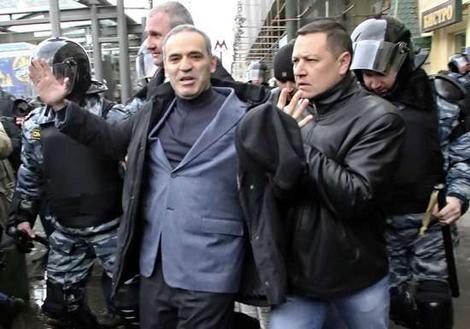
As everybody, I was watching the news to see Gary Kasparov arrested last week while he protested against Putin's regime. The media were unanimous to condemn this act of intimidation towards a citizen, willing to exercise his freedom of speech and opposition before the elections on Sunday. They pointed out that this kind of repression doesn't forecast anything good for democracy in Russia.

Well, well, well... Look at this picture. Date: September 11, 2007. Location: Brussels. Event: a peaceful demo aimed at commemorating the WTC and Pentagon attacks on 9/11 and to draw attention to the creeping Islamization of Western society - a demo forbidden by Brussels Socialist mayor Thielemans. Freedom of speech? Not in Brussels.

The guy assaulted by policemen in the picture is not a common individual. He's the President of a party voted for by 20% of the electorate, a former Belgian senator, and currently a MEP. I fully agree that this party doesn't look friendly to the remaining 80% (and me) and that the guy isn't very sympathetic. A far right guy... But anyway : he represents many citizens, was voted in democratically.

Nobody in the Belgian media protested against his brutal arrest. Why? To me, there's no difference between the two cases: between the arrest of Kasparov and our Belgian bad guy. It's not the responsibility of authorities to decide who is pleasant (or whom to vote for) or not.

The problem is, we have to deal in Belgium with an archaic Left-wing nomenklatura. In the end, I believe what distinguishes Left from Right is the level of confidence in a population. Leftists believe people can't be trusted. In their minds, the totalitarian temptation will always prevail. Ergo, they believe they have to tell people who is votable or not, who has a reasonable political vision or not.

To push this belief the whole way, they even created what they call a "cordon sanitaire" (line of quarantine) around this particular party: the party won't be part of any coalition, there'll be no debate with its leaders, and the media must do their best to ignore them.

That's what they call protective democracy, and that's what I call the beginning of a dictatorship.

After all, the essential thing is not that the Belgian Leftists isolate a party and its leaders, IT'S THAT THEY ISOLATE 20% OF THE ELECTORATE - AND ABOVE ALL - THAT THEY ISOLATE THE POLITICAL ISSUES NOURISHED BY THE FAR RIGHT MOVEMENT, NAMELY INSECURITY AND UNCONTROLLED IMMIGRATION.

Tackling those problems would be considered a break in the cordon sanitaire, as far Rightist parties end up being the only ones bringing these matters up. My opinion instead is, that in a democracy, no subject should be ignored. The best way to fight extremist parties is to find solutions to the problems they point out.

That is what Nicolas Sarkozy did so courageously during the French campaign last spring, shocking Leftists who accused him of flirting with Jean-Marie Le Pen, leader of Front National, the far Rightist party dealing with the same kind of ban we find in Belgium. Result: Sarkozy was easily elected while Jean-Marie Le Pen suffered his worst defeat.

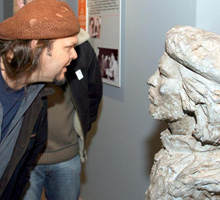
Back to the situation in Belgium, it's pretty obvious that Leftists don't act towards certain parties out of political ethics. We are experiencing a clear demonstration of their lack of political morality these days: an exhibition is taking place in Stavelot (in a former (medieval) abbey!!!) to record Ernesto Che Guevara and his "works". And on this occasion, local authorities were very proud to welcome Camillo, son of the famous MURDERER WHO FOUGHT DEMOCRACY FROM THE MOMENT HE CAME INTO POWER.

So, is a far Rightist leader believed to have an undemocratic vision equal to a former far Leftist leader, convinced of an undemocratic vision? Not in Belgium, ladies and gentlemen!

There are many examples of undemocratic sliding in Belgium. Just one of them: because of the Belgian voting system, voters in (French speaking) Wallonia never get the opportunity to reward or penalize the former Prime Minister in an election, because the guy is automatically Flemish and Walloons can't vote for a Flemish candidate!

And undemocratic sliding isn't exclusively Belgian either ... I believe we can find it all over Western Europe. For instance in Italy the Leftist coalition of Romano Prodi is working on a law called "Levi-Prodi Act" to silence Italian bloggers! This law foresees that you should be able to create a blog only if you're backed by an accredited journalist. Moreover, you should pay a tax for the blog, even though you don't make money out of it!

I could also talk about EU and our mysterious MEPs ... and so on. Fellow readers, I'm curious to know if you are also experiencing some strange behavior in your countries. Drop us a line ... (or visit the Forum)

I may be missing something, but my feeling is there's something rotten in the state of Europe ...

 
RatePoint Business Reviews